Perpetual DEXs have become a serious part of crypto trading. They combine leverage and short selling with onchain infrastructure, giving traders an alternative to traditional centralized exchanges.
But the differences between Perp DEXs are significant.
Some focus on deep liquidity and professional trading. Others compete on zero fees, massive market selection or access to stocks and other real world assets.
Here are the 5 best Perp DEXs in 2026, based on their trading infrastructure, fees, markets, liquidity, features and overall experience.
Download the 0fiat app on Android and start spending crypto directly from your wallet
Perp DEX Comparison
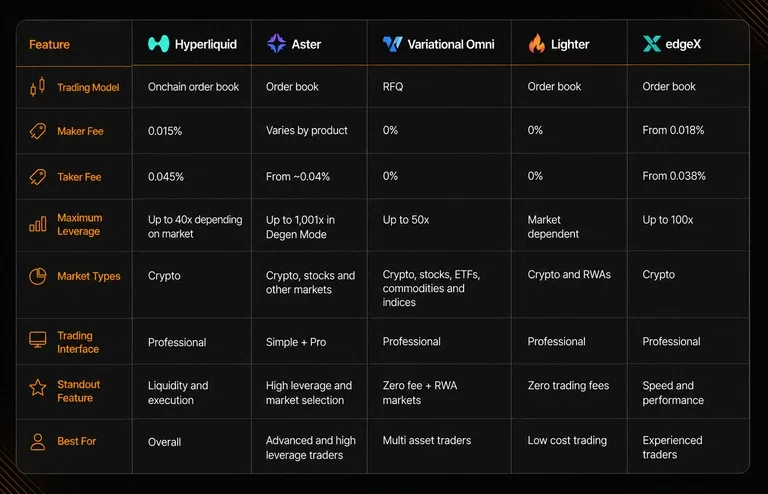
Feature | Hyperliquid | Aster | Variational Omni | Lighter | edgeX |
Trading Model | Onchain order book | Order book | RFQ | Order book | Order book |
Maker Fee | 0.015% | Varies by product | 0% | 0% | From 0.018% |
Taker Fee | 0.045% | From ~0.04% | 0% | 0% | From 0.038% |
Maximum Leverage | Up to 40x depending on market | Up to 1,001x in Degen Mode | Up to 50x | Market dependent | Up to 100x |
Market Types | Crypto | Crypto, stocks and other markets | Crypto, stocks, ETFs, commodities and indices | Crypto and RWAs | Crypto |
Trading Interface | Professional | Simple + Pro | Professional | Professional | Professional |
Standout Feature | Liquidity and execution | High leverage and market selection | Zero fee + RWA markets | Zero trading fees | Speed and performance |
Best For | Overall | Advanced and high leverage traders | Multi asset traders | Low cost trading | Experienced traders |
Fees and leverage can vary by market, account, product and risk parameters.
The table makes one thing clear: there is no single winner across every category.
Hyperliquid dominates when liquidity and overall trading experience are the priority. Aster pushes the boundaries on leverage and market selection. Variational Omni takes perpetual trading beyond crypto. Lighter competes aggressively on fees, while edgeX focuses on performance.
Now let's look at each one in more detail.
1. Hyperliquid
Best For: Overall Perp DEX Trading
Hyperliquid is the benchmark that most other Perp DEXs are trying to challenge.
Its biggest advantage is the combination of liquidity, execution, market depth and trading experience. Instead of relying on a traditional AMM, Hyperliquid uses an onchain order book designed to support professional trading.
It currently offers hundreds of perpetual markets and has become one of the largest venues for onchain derivatives.
Hyperliquid Key Details
Feature | Details |
Trading Model | Onchain order book |
Maker Fee | 0.015% baseline |
Taker Fee | 0.045% baseline |
Leverage | Up to 40x depending on market |
Markets | 400+ perpetual markets |
Order Types | Market, limit and advanced order types |
Funding | Periodic funding between longs and shorts |
Collateral | Primarily USDC based |
Network | Hyperliquid L1 |
Native Token | HYPE |
The 0.015% maker and 0.045% taker rates are the baseline rates. High volume traders can qualify for lower fees.
The biggest reason to choose Hyperliquid isn't necessarily the lowest fee. It is execution quality and liquidity.
For a trader opening a large position, a slightly higher trading fee can be preferable to a cheaper platform with significantly more slippage.
What Makes Hyperliquid Different?
Hyperliquid has effectively tried to bring the trading experience of a centralized exchange onchain.
That means a familiar order book, fast execution, advanced trading functionality and deep markets, while retaining an onchain settlement architecture.
Best for: Traders who want the strongest all around Perp DEX experience.
2. Aster
Best For: Market Selection And High Leverage
Aster is one of the most aggressive competitors in the Perp DEX market.
Its major advantages are market selection, leverage and multiple trading modes.
The platform supports standard perpetual trading while also offering Degen Mode, which is designed for extremely high leverage.
Aster Key Details
Feature | Details |
Trading Model | Order book |
Standard Perp Leverage | Up to 75x |
Degen Mode | Up to 1,001x |
Standard Trading Fee | Varies by product |
Degen Mode Fee | 0.08% open/close under the documented model |
Markets | 500+ perpetual markets |
Trading Modes | Simple, Pro and Degen |
Market Types | Crypto and selected traditional asset markets |
Funding | Periodic funding |
Collateral | Stablecoin based |
Standout Feature | Very high leverage |
Aster's 1,001x Degen Mode is obviously not designed for the average trader. At that level of leverage, tiny price movements can have enormous consequences.
For most users, the standard perpetual product is considerably more relevant.
The bigger everyday advantage is the platform's broad market selection. Traders looking for smaller altcoin markets have more choices than they will find on many competing Perp DEXs.
What Makes Aster Different?
Aster is effectively attacking the Perp DEX market from two directions:
More markets + more leverage.
That makes it particularly attractive to traders who want access to assets outside the usual BTC and ETH perpetuals.
Best for: Experienced traders who want extensive market selection and high leverage options.
3. Variational Omni
Best For: Crypto And Real World Asset Trading
Variational Omni is probably the most unconventional platform on this list.
Instead of limiting itself to cryptocurrency perpetuals, Omni allows traders to access markets covering crypto, stocks, ETFs, commodities and indices.
That makes it closer to an onchain derivatives marketplace than a conventional crypto only Perp DEX.
Variational Omni Key Details
Feature | Details |
Trading Model | Request for Quote |
Trading Fee | 0% |
Leverage | Up to 50x on eligible markets |
Markets | 500+ markets |
Crypto Markets | Yes |
Stocks | Yes |
ETFs | Yes |
Commodities | Yes |
Indices | Yes |
Funding | Market dependent |
Liquidity Model | Professional liquidity provider |
Standout Feature | Crypto + TradFi/RWA perpetuals |
The zero fee model is particularly interesting.
Instead of charging a conventional maker or taker fee, Omni uses an RFQ system where prices are quoted by its liquidity provider. That means traders still need to pay attention to the quoted price and spread, rather than assuming “0% fee” automatically means the cheapest execution.
This distinction is important when comparing Perp DEXs.
What Makes Variational Omni Different?
It is trying to expand the definition of what a crypto derivatives platform can be.
Instead of asking, “Which token do you want to trade?”
Omni increasingly lets traders ask, “Which market do you want to trade?”
Best for: Traders who want crypto, stocks, ETFs, commodities and other markets in one derivatives platform.
4. Lighter
Best For: Low Cost Trading
Lighter has built its reputation around one simple proposition:
Zero trading fees.
Its Standard Accounts currently have 0% maker and 0% taker fees for perpetual futures and spot trading.
Lighter Key Details
Feature | Details |
Trading Model | Onchain order book |
Maker Fee | 0% for Standard Accounts |
Taker Fee | 0% for Standard Accounts |
Leverage | Market dependent |
Perpetual Markets | 200+ |
Spot Trading | Yes |
RWA Markets | Yes |
Infrastructure | Zero knowledge based |
Collateral | Multi asset margin |
Funding | Market dependent |
Standout Feature | Zero trading fees |
Lighter's architecture uses zero knowledge technology to provide verifiable trading while attempting to retain the speed traders expect from centralized exchanges.
It also supports multi asset margin, allowing users to use supported assets as collateral rather than relying on one single collateral asset.
But zero trading fees should not be confused with zero trading costs.
Traders still need to consider funding, liquidation fees, spreads and slippage.
Lighter's documentation also notes that its liquidation engine can charge a liquidation fee of up to 1% in certain circumstances.
What Makes Lighter Different?
The fee structure.
For traders who open and close many positions, eliminating maker and taker fees can have a meaningful impact on total trading costs.
Best for: Active traders who prioritize minimizing trading fees.
5. edgeX
Best For: Performance And Advanced Trading
edgeX focuses heavily on speed and trading infrastructure.
Rather than trying to win purely through zero fees or the largest possible market catalogue, edgeX positions itself as a high performance derivatives venue for experienced traders.
edgeX Key Details
Feature | Details |
Trading Model | Order book |
Maker Fee | From 0.018% |
Taker Fee | From 0.038% |
Leverage | Up to 100x |
Perpetual Markets | 200+ |
Order Book | Yes |
Trading Style | Professional |
VIP Discounts | Yes |
Settlement | Onchain |
Standout Feature | High performance infrastructure |
The standard fee structure is already competitive, and higher volume traders can access lower rates through VIP tiers.
edgeX also advertises very high throughput and low matching latency, making execution speed a major part of its proposition.
What Makes edgeX Different?
edgeX is designed around the idea that performance matters as much as decentralization.
For active traders, the difference between a fast and slow execution environment can be more important than a small difference in trading fees.
Best for: Experienced traders who prioritize execution speed and advanced trading infrastructure.
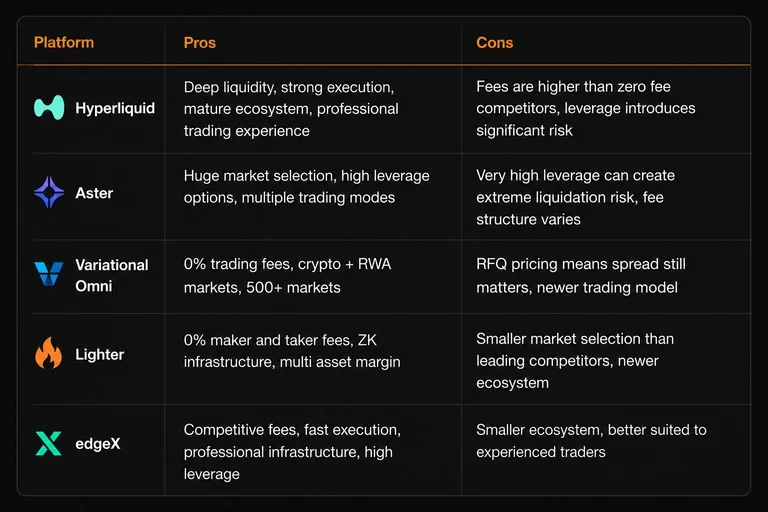
Pros And Cons
Platform | Pros | Cons |
Hyperliquid | Deep liquidity, strong execution, mature ecosystem, professional trading experience | Fees are higher than zero fee competitors, leverage introduces significant risk |
Aster | Huge market selection, high leverage options, multiple trading modes | Very high leverage can create extreme liquidation risk, fee structure varies |
Variational Omni | 0% trading fees, crypto + RWA markets, 500+ markets | RFQ pricing means spread still matters, newer trading model |
Lighter | 0% maker and taker fees, ZK infrastructure, multi asset margin | Smaller market selection than leading competitors, newer ecosystem |
edgeX | Competitive fees, fast execution, professional infrastructure, high leverage | Smaller ecosystem, better suited to experienced traders |
How We Selected The Best Perp DEXs
A Perp DEX shouldn't be judged purely by today's trading volume.
Volume and open interest are useful indicators, but they change every day. For a comparison that remains useful over time, we focused on characteristics that matter to traders regardless of the current market cycle.
Liquidity
Liquidity determines how easily traders can enter and exit positions.
A platform with lower fees isn't necessarily cheaper if large orders experience significant slippage.
Trading Fees
Maker and taker fees are important, particularly for active traders.
However, the headline fee isn't the complete cost of trading. Funding rates, spreads, network costs and liquidation fees can also affect the final cost.
Leverage
Higher leverage isn't automatically better.
It gives traders more capital efficiency but also brings liquidation closer to the entry price.
We considered the available leverage because it is an important part of the trading experience, not because maximum leverage should determine which platform is best.
Markets
A good Perp DEX needs more than BTC and ETH.
The ability to trade altcoins, commodities, stocks, ETFs and other assets can significantly expand the usefulness of a platform.
Trading Infrastructure
We looked at the underlying trading model, order books, matching engines, settlement architecture and overall execution experience.
User Experience
Finally, we considered how practical each platform is for an actual trader.
A platform can have impressive technology but still be difficult to use. The best Perp DEXs combine sophisticated infrastructure with a trading interface that users can actually navigate.
Which Perp DEX Is Best In 2026?
Hyperliquid is the best overall Perp DEX in 2026 for traders who want the strongest combination of liquidity, execution, markets and trading experience.
But the alternatives are becoming increasingly compelling.
Choose Aster if market selection and high leverage are your priorities.
Choose Variational Omni if you want to trade crypto alongside stocks, ETFs, commodities and other real world assets.
Choose Lighter if minimizing trading fees is your biggest priority.
Choose edgeX if you are an experienced trader looking for high performance infrastructure.
The interesting part of the Perp DEX market in 2026 is that the competition is no longer simply about who can offer perpetual futures.
It is now a competition over liquidity, execution, fees, leverage, market selection and trading infrastructure.
And that competition is making decentralized derivatives much more interesting than they were just a few years ago.
You May Also Be Intersted in Reading:
How to Buy Google Play Gift Cards with Crypto
How To Buy Prepaid Mastercard with Crypto
Frequently Asked Questions (FAQs)
What is a Perp DEX?
A Perp DEX is a decentralized exchange that allows users to trade perpetual futures contracts. These contracts have no fixed expiry date and allow traders to take long or short positions, often with leverage.
What is the best Perp DEX in 2026?
Hyperliquid is the strongest overall choice based on its combination of liquidity, trading infrastructure, market depth and user experience.
Which Perp DEX has zero trading fees?
Lighter currently offers 0% maker and taker fees for Standard Accounts. Variational Omni also operates with zero trading fees, although traders should consider its quoted prices and spreads.
Which Perp DEX offers the highest leverage?
Aster offers up to 1,001x leverage through its Degen Mode. This is an extremely high risk trading product and is very different from standard perpetual trading.
What is the difference between a Perp DEX and a centralized exchange?
A Perp DEX uses decentralized or onchain infrastructure for derivatives trading, while a centralized exchange generally operates through a centralized trading and custody system.
Are Perp DEXs safe?
No trading platform is risk free. Traders should consider smart contract risk, liquidation risk, oracle mechanisms, liquidity, custody architecture and the platform's security history before depositing funds.
Are Perp DEXs suitable for beginners?
Perpetual futures are generally more complex and risky than spot trading. Leverage can amplify losses very quickly, so beginners should understand margin, funding, liquidation and position sizing before trading.
Do Perp DEXs charge funding fees?
Most perpetual markets use funding mechanisms to keep the perpetual contract price aligned with its underlying market. The funding rate and payment frequency can differ between platforms and individual markets.