Decentralised exchanges have become a core part of crypto trading. You can swap tokens directly from your wallet, provide liquidity, and access markets without opening an account on a traditional centralised exchange.
Here are the 5 best DEXes in 2026, and what each one is best at.
DEX Comparison
Every decentralized exchange(DEX) has a different strength.
Uniswap dominates Ethereum and other major networks, PancakeSwap has built a huge multichain ecosystem, Orca is a major force on Solana, Aerodrome is deeply integrated into Base, and Curve remains a specialist for stablecoins and correlated assets.
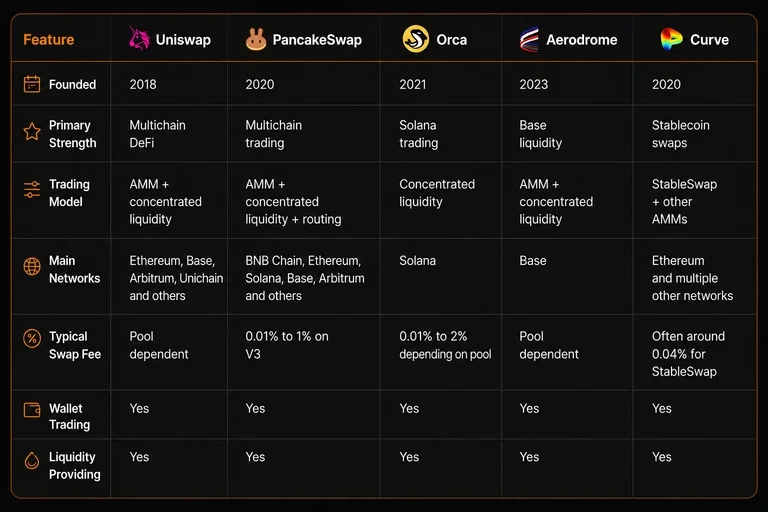
Fee structures vary by pool, protocol version, network and routing method.
The biggest difference between these platforms is not simply their size. It is what they are optimised for.
Uniswap is the strongest all rounder. PancakeSwap offers one of the broadest DEX ecosystems. Orca is built around Solana's speed and concentrated liquidity. Aerodrome is deeply connected to Base, while Curve is purpose built for efficient trading between assets that are expected to maintain similar values.
Try 0fiat - a DEX alternative to spend your crypto without fees, conversions and hassle
1. Uniswap
Best For: Overall DEX Trading
Uniswap remains the benchmark for decentralised exchanges.
It started with a relatively simple automated market maker model and has evolved into a sophisticated liquidity infrastructure spanning multiple versions and blockchain networks.
Its latest major architecture, Uniswap v4, gives liquidity providers much more flexibility through hooks, which allow developers to customize how pools behave.
Uniswap v3 introduced concentrated liquidity, allowing liquidity providers to choose specific price ranges rather than spreading their capital across the entire possible price curve.
Uniswap Key Details
Feature | Details |
Founded | 2018 |
Trading Model | AMM and concentrated liquidity |
Versions | V2, V3 and V4 |
Fee Structure | Pool dependent |
V3 Standard Tiers | 0.05%, 0.30% and 1% |
V4 Fees | Customisable by pool creators |
Wallet Trading | Yes |
Liquidity Providing | Yes |
Governance Token | UNI |
Key Technology | Concentrated liquidity and V4 hooks |
One of Uniswap's biggest advantages is its network coverage.
Instead of being tied to one blockchain, Uniswap has expanded across Ethereum and multiple Layer 2 and other supported networks.
That makes it particularly useful for users who move between different parts of the Ethereum ecosystem.
For traders, this means the fee attached to a swap depends on the specific pool and route.
Why Uniswap Stands Out
Uniswap has the combination that matters most for a general purpose DEX:
Large ecosystem
Multichain availability
Deep liquidity across major markets
Concentrated liquidity
Mature smart contract infrastructure
Advanced V4 functionality
Large developer ecosystem
Best for: Users who want the most established all round DEX experience.
2. PancakeSwap
Best For: Multichain Trading
PancakeSwap has evolved far beyond its original BNB Chain roots.
Today, it operates across multiple networks and combines token swaps with liquidity pools, farming, cross chain swaps, perpetual trading and other DeFi products.
It currently supports major networks including BNB Chain, Ethereum, Solana, Base, Arbitrum, Aptos, zkSync, Linea, opBNB and others.
PancakeSwap Key Details
Feature | Details |
Founded | 2020 |
Trading Model | AMM, concentrated liquidity and routing |
V2 Fee | 0.25% |
V3 Fee Tiers | 0.01%, 0.05%, 0.25%, 1% |
Networks | 10+ supported networks |
Wallet Trading | Yes |
Liquidity Providing | Yes |
Cross Chain Swaps | Yes |
Governance Token | CAKE |
Other Products | Perpetuals, farms, launch products and more |
PancakeSwap's routing system is another important feature.
Rather than forcing every trade through one liquidity source, its smart router can compare different pools and liquidity sources to find an appropriate route.
This can make a major difference when trading less liquid assets.
Its V3 pools use different fee tiers, from 0.01% to 1%, while V2 uses a fixed 0.25% swap fee.
PancakeSwap also offers cross chain swaps, allowing users to move between supported networks through its interface without manually managing every part of the process.
Why PancakeSwap Stands Out
PancakeSwap is particularly strong if you want one DeFi interface with lots of different products.
You can swap tokens, provide liquidity, farm, use cross chain functionality and access derivatives from the same broader ecosystem.
Best for: Multichain users and traders who want more than basic token swaps.
3. Orca
Best For: Solana Trading
Orca is one of the leading DEXs built specifically around Solana.
Rather than trying to compete everywhere, Orca has focused on making trading and liquidity provision efficient within the Solana ecosystem.
Its core technology is Whirlpools, a concentrated liquidity automated market maker.
Orca Key Details
Feature | Details |
Founded | 2021 |
Primary Network | Solana |
Trading Model | Concentrated liquidity AMM |
Core Product | Whirlpools |
Lowest Fee Tier | 0.01% |
Common Fee Tiers | 0.01%, 0.02%, 0.04%, 0.05%, 0.16%, 0.30%, 0.65%, 1%, 2% |
Wallet Trading | Yes |
Liquidity Providing | Yes |
Governance Token | ORCA |
Standout Feature | Solana focused concentrated liquidity |
Orca's concentrated liquidity model allows liquidity providers to specify the price ranges where they want their capital to be active.
For traders, concentrated liquidity can potentially provide better capital efficiency and lower slippage when sufficient liquidity exists around the current price.
Orca also integrates quote routing into its trading experience, allowing users to compare available liquidity rather than simply interacting with a single pool.
Another advantage is Solana itself.
Transactions on Solana are generally much cheaper and faster than transactions on Ethereum mainnet, making Orca particularly attractive for users who make frequent smaller swaps.
Why Orca Stands Out
Orca doesn't need to be everything to everyone.
It focuses on doing Solana DeFi extremely well.
For someone trading SOL, USDC, major Solana tokens or newer Solana assets, Orca is one of the first DEXs worth checking.
Best for: Solana users and traders looking for efficient onchain swaps.
4. Aerodrome
Best For: Base
Aerodrome has become a central piece of the Base DeFi ecosystem.
It was designed as a liquidity hub for Base and combines traditional AMM functionality with concentrated liquidity through Slipstream.
Aerodrome Key Details
Feature | Details |
Founded | 2023 |
Primary Network | Base |
Trading Model | AMM + concentrated liquidity |
Slipstream Fee Tiers | 0.01%, 0.05%, 0.30%, 1% defaults |
V1 Stable Pool Fee | Around 0.05% baseline |
V1 Volatile Pool Fee | Around 0.30% baseline |
Governance Token | AERO |
Voting System | veAERO |
Liquidity Incentives | AERO emissions and voting incentives |
Standout Feature | Base liquidity hub |
Aerodrome's biggest differentiator is its liquidity incentive system.
The protocol uses veAERO governance, allowing participants to vote on which pools should receive emissions. Projects can also use incentives to attract liquidity to specific markets.
This creates a flywheel:
More liquidity can attract more trading.
More trading generates fees.
Liquidity incentives can then encourage providers to remain active in important pools.
Aerodrome's Slipstream product also uses concentrated liquidity, giving liquidity providers more control over where their capital is deployed.
Why Aerodrome Stands Out
The aerodrome is closely tied to Base's growth.
For users who primarily operate on Base, it can be one of the most important places to look for liquidity and token swaps.
It is also an interesting example of how modern DEXs are evolving beyond simple swap interfaces into liquidity coordination platforms.
Best for: Base users and traders looking for Base native liquidity.
5. Curve
Best For: Stablecoin And Correlated Asset Swaps
Curve is different from the other DEXs on this list.
While Uniswap and Orca are designed as broad general purpose trading platforms, Curve became famous for something much more specific:
Trading assets that are supposed to have similar values.
Think USDC against USDT, stablecoins against other stablecoins, or certain liquid staking and wrapped assets.
Curve's StableSwap design reduces price impact when assets are close in value.
Curve Key Details
Feature | Details |
Founded | 2020 |
Trading Model | StableSwap and other specialised AMMs |
Typical StableSwap Fee | Often around 0.04% |
Fee Model | Pool dependent |
Networks | Multichain |
Wallet Trading | Yes |
Liquidity Providing | Yes |
Governance Token | CRV |
Core Strength | Stable and correlated asset liquidity |
Key Feature | Low slippage for suitable asset pairs |
Curve's StableSwap pools are designed specifically for assets that should trade near a fixed ratio.
This is important because a normal constant product AMM is not always the most efficient design for stablecoins.
Curve's pools can provide significantly better capital efficiency for these types of swaps, although the advantage depends on the assets and pool.
Curve also has a broad ecosystem around CRV, veCRV and liquidity incentives, making it an important piece of DeFi infrastructure beyond simply swapping tokens.
Why Curve Stands Out
If you're swapping one stablecoin for another, the biggest DEX isn't necessarily the best DEX.
Curve's specialised AMM design is built specifically for this problem.
It is also widely integrated into other DeFi applications, meaning users can interact with Curve liquidity without necessarily visiting Curve directly.
Best for: Stablecoin traders and users swapping closely correlated assets.
Pros And Cons
DEX | Pros | Cons |
Uniswap | Large ecosystem, broad network support, deep liquidity, advanced concentrated liquidity, mature infrastructure | Pool fees vary, Ethereum transactions can be expensive, concentrated liquidity is more complex for LPs |
PancakeSwap | Multichain support, broad product ecosystem, multiple fee tiers, cross chain swaps, strong routing | Large ecosystem can feel complex, fees vary by pool and network |
Orca | Fast and low cost Solana transactions, concentrated liquidity, simple interface, strong Solana ecosystem integration | Primarily focused on Solana, pool selection and liquidity vary by asset |
Aerodrome | Strong Base liquidity, concentrated liquidity, liquidity incentives, veAERO voting system | Primarily Base focused, more complex for users interested only in simple swaps |
Curve | Excellent for stablecoins, specialised AMM design, low slippage for correlated assets, strong DeFi integrations | Less suitable for highly volatile token pairs, pool mechanics can be complex for beginners |
How We Selected The Best DEXes
There are hundreds of decentralised exchanges, so ranking them purely by one day's trading volume would not produce a particularly useful list.
Instead, we looked at several factors.
Liquidity
Liquidity is one of the most important factors when choosing a DEX.
A platform may advertise a very low fee, but poor liquidity can result in significant slippage.
For larger trades, the actual execution price can matter much more than the headline fee.
Trading Fees
DEX fees are rarely as simple as saying "this DEX charges 0.3%."
Many modern DEXs have multiple pools with different fee tiers.
The actual cost can depend on:
Pool type
Fee tier
Trading pair
Network
Routing
Price impact
This is why traders should always check the final quote before approving a transaction.
Network Coverage
A DEX that works across multiple networks is useful for users who hold assets across different ecosystems.
Uniswap and PancakeSwap are particularly strong here.
Other platforms have taken a more specialised approach. Orca focuses heavily on Solana, while Aerodrome is deeply integrated into Base.
Trading Model
The underlying design also matters.
Some DEXs use traditional AMMs. Others use concentrated liquidity, specialised stablecoin curves, order books or combinations of different liquidity sources.
The best model depends on what you are trading.
Security And Maturity
Smart contract risk is one of the most important differences between DEXs and centralised exchanges.
We therefore considered the maturity of each protocol, its development history, ecosystem adoption and available security information.
That does not mean any DEX is risk free.
A smart contract exploit, malicious token, compromised wallet or incorrectly configured transaction can still result in permanent losses.
Which DEX Is Best In 2026?
Uniswap is the best overall DEX for most users.
Its combination of liquidity, network coverage, mature infrastructure and broad ecosystem makes it the most versatile option.
But the best DEX depends heavily on what you're actually doing.
Choose Uniswap for general purpose DeFi and broad network coverage.
Choose PancakeSwap if you want a multichain DEX with a large collection of additional DeFi products.
Choose Orca if you're primarily trading on Solana.
Choose Aerodrome if Base is your main ecosystem.
Choose Curve if you're swapping stablecoins or other closely correlated assets.
The biggest lesson is that there is no reason to treat a DEX like a bank or exchange where you have to pick one platform and stick with it.
A crypto user can use Uniswap for an Ethereum trade, Orca for Solana, Aerodrome for Base and Curve for a stablecoin swap.
The best DEX is often the one with the best liquidity and execution for the specific trade you are trying to make.
10 Best Crypto Exchanges to Use in 2026
Top 5 crypto Credit Cards to Use in 2026: Full List
Use Your Crypto Beyond Trading
0fiat brings that same self custody approach to everyday online purchases. Instead of moving your USDT or USDC to an exchange, converting it to fiat, or relying on a crypto card, you can pay directly from your own wallet at 190+ supported stores across 45+ countries.
There are no 0fiat transaction fees, no KYC, and no need to preload a card. Simply shop normally, select 0fiat at checkout, choose your supported stablecoin and network, and approve the payment from your wallet.
Trade your crypto onchain. Keep it self custodial. And when you're ready to spend, use 0fiat.
Frequently Asked Questions (FAQs)
What is a DEX?
A decentralised exchange is a blockchain based platform that allows users to swap crypto assets directly from their wallets without depositing funds into a traditional centralised exchange.
Which is the best DEX in 2026?
Uniswap is the strongest overall choice because of its broad ecosystem, liquidity, network coverage and mature infrastructure. However, the best DEX depends on the blockchain and assets being traded.
Is Uniswap better than PancakeSwap?
Neither is universally better. Uniswap has a particularly strong position across Ethereum and its Layer 2 ecosystem, while PancakeSwap offers broad multichain support and a large collection of additional DeFi products.
What is the best DEX for Solana?
Orca is one of the leading Solana focused DEXs and is particularly known for its concentrated liquidity system. Solana users should also compare available liquidity and the final quote before completing a swap.
What is the best DEX for Base?
Aerodrome is one of the most important DEXs in the Base ecosystem and is specifically designed around Base liquidity.
What is the best DEX for stablecoins?
Curve is one of the strongest options for stablecoin and correlated asset swaps because its StableSwap design is specifically optimised for assets that are expected to trade close to the same value.
Are DEXs cheaper than centralised exchanges?
Not always. DEX users don't pay a traditional exchange trading fee in the same way as a centralised exchange, but they can still pay pool fees, network gas, price impact and other routing costs. The final quote is what matters.
Do I need an account to use a DEX?
Usually not. Most DEXs allow users to connect a compatible crypto wallet and trade directly. You generally do not need to create a traditional exchange account.
Are DEXs safe?
DEXs remove some of the risks associated with handing funds to a centralised exchange, but they introduce other risks. Smart contract vulnerabilities, malicious tokens, phishing attacks, wallet compromises, bridge risks and transaction mistakes can all result in losses.
Can I provide liquidity on a DEX?
Yes. Most major DEXs allow users to deposit assets into liquidity pools and earn a share of trading fees. However, liquidity providers face risks including impermanent loss and, depending on the protocol, smart contract and token risks.