Stocks have traditionally lived inside a financial system built around brokers, exchanges, clearing houses, custodians, and fixed market hours. Blockchain technology is beginning to change how those assets can be issued, transferred, and traded.
Tokenized stocks represent stocks or equity interests as blockchain-based assets. Instead of ownership being recorded only through traditional financial infrastructure, some or all of the ownership record is represented on a blockchain. The result can make equities more portable, programmable, and easier to integrate with digital financial applications.
The market is already growing. RWA.xyz currently tracks more than $2.9 billion in distributed tokenized-stock value, with millions of holders and nearly $12.7 billion in monthly transfer volume.
But "tokenized stock" does not describe one single type of product. The legal rights, underlying assets, custody arrangements, and investor protections can differ substantially depending on how a stock is tokenized.
What Are Tokenized Stocks?
Tokenized stocks are blockchain-based representations of stocks or equity interests.
At the simplest level, the idea is:
Traditional stock → blockchain representation → token
Instead of the ownership record existing entirely within a broker and traditional securities infrastructure, a blockchain can be used to record ownership or represent an investor's economic interest.
The U.S. SEC describes tokenized securities as financial instruments such as stocks, bonds, or fund interests that are formatted as or represented by crypto assets, with ownership recorded partly or entirely through a crypto network.
However, tokenization does not automatically change the underlying economics of a stock. A token representing Apple, for example, does not magically become a different type of company ownership simply because it exists on a blockchain.
What matters is what the token legally represents and what rights the holder receives.
How Do Tokenized Stocks Work?
There are several ways to tokenize a stock.
A simplified structure looks like this:
1. The Underlying Stock Is Acquired
In a custodial model, the tokenization provider acquires the corresponding shares and holds them with a custodian.
2. A Blockchain Token Is Created
A token is issued to represent the underlying security or an economic interest in it.
3. The Token Is Distributed
The token can then be made available through an exchange, wallet, or other financial platform.
4. Investors Hold the Token
Depending on the structure, investors can hold the token in a brokerage account, exchange account, or compatible self-custody wallet.
5. The Token Tracks the Underlying Asset
The token's value is generally designed to track the value of the underlying stock.
This sounds straightforward, but the legal and financial structure behind each token can be very different.
The Three Main Types of Tokenized Stocks
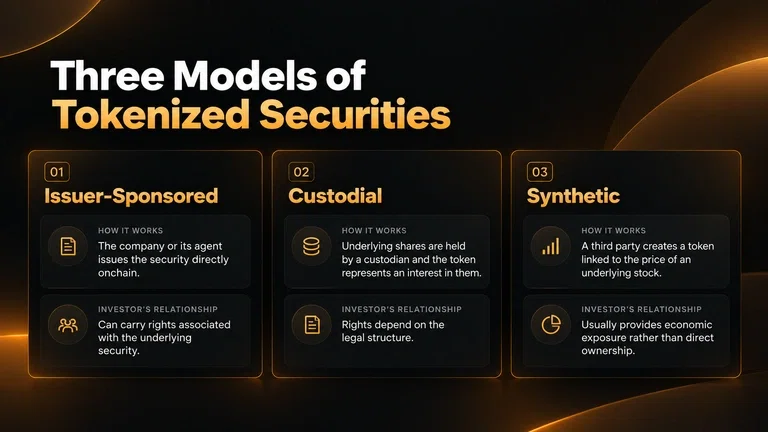
The SEC and Investor.gov broadly describe three models that are useful for understanding the market: issuer-sponsored, custodial, and synthetic tokenized securities.
Model | How It Works | Investor's Relationship |
Issuer-sponsored | The company or its agent issues the security directly onchain | Can carry rights associated with the underlying security |
Custodial | Underlying shares are held by a custodian and the token represents an interest in them | Rights depend on the legal structure |
Synthetic | A third party creates a token linked to the price of an underlying stock | Usually provides economic exposure rather than direct ownership |
This distinction is extremely important.
Two tokens could both track the price of NVIDIA but provide completely different legal rights and protections.
Tokenized Stock vs Traditional Stock
Tokenization does not necessarily make an investment better or worse. It changes the infrastructure through which the investment can be held and transferred.
Feature | Traditional Stock | Tokenized Stock |
Ownership record | Traditional securities infrastructure | Blockchain or hybrid infrastructure |
Trading | Exchange/broker infrastructure | Exchange, broker, or onchain venue |
Settlement | Traditional clearing and settlement | Can potentially settle onchain |
Market hours | Usually defined | Some tokens can trade outside market hours |
Fractional ownership | Supported by many brokers | Common in tokenized products |
Self-custody | Generally unavailable | Possible with some structures |
DeFi integration | Very limited | Possible |
Shareholder rights | Generally applicable | Depends on token structure |
Blockchain transfer | No | Possible with compatible tokens |
The key point is that "tokenized stock" does not automatically mean "stock in a crypto wallet."
The rights attached to the token depend on its legal structure.
Why Put Stocks on a Blockchain?
There are several reasons financial institutions and crypto companies are exploring tokenization.
Faster Settlement
Traditional securities transactions pass through multiple layers of market infrastructure.
Blockchain-based settlement can potentially reduce the number of intermediaries involved and allow assets and payment to settle directly through programmable infrastructure.
The SEC has specifically highlighted the potential for tokenization to modernize issuance, trading, transfer, settlement, and ownership records.
24/7 Markets
Traditional U.S. stock exchanges operate during defined market sessions.
Tokenized stocks can potentially trade outside those hours on blockchain-based secondary markets.
For example, xStocks states that its tokens can trade 24/7 on supported secondary markets, even though primary issuance and redemption operate around the underlying market's business hours.
This creates an important distinction:
The underlying stock is not necessarily trading 24/7. The token representing it can be.
Fractional Ownership
Blockchain-based assets can be divided into smaller units, making fractional exposure straightforward.
Some tokenized-stock platforms allow investors to purchase very small amounts of an asset rather than an entire share.
This can be particularly useful for high-priced stocks and for users accessing financial markets from countries where traditional brokerage access may be limited.
Global Distribution
A blockchain token can potentially move across borders without relying entirely on traditional financial rails.
This is one reason tokenized securities are attracting attention from crypto exchanges and financial institutions.
However, global availability does not mean global regulatory access. Tokenized securities remain subject to securities laws and jurisdictional restrictions.
Self-Custody
Some tokenized stocks can be withdrawn from exchanges and held in compatible blockchain wallets.
This introduces a new possibility for equities: the investor can potentially control the wallet holding the asset instead of keeping the asset entirely within a brokerage account.
Not every tokenized stock supports this model.
Tokenized Stocks and DeFi
One of the biggest differences between tokenized equities and conventional stocks is composability.
Once a stock exists as a blockchain token, it can potentially interact with smart contracts.
For example, a tokenized stock could potentially be:
Used as collateral
Deposited into a lending protocol
Used in a liquidity pool
Swapped against stablecoins
Held in a self-custody wallet
Integrated into automated financial strategies
This is where tokenization goes beyond simply creating a digital version of a stock.
The goal is to make financial assets programmable.
Imagine holding a tokenized ETF and using it as collateral for a stablecoin loan without selling the underlying exposure. That type of interaction is difficult to achieve using conventional brokerage infrastructure but is possible in principle with blockchain-based assets.
Some existing tokenized-equity products are already being integrated into DeFi protocols.
What Happens to Dividends?
Dividends are another area where tokenized stocks can work differently from traditional shares.
The treatment depends on the product structure.
For example, xStocks reinvest dividends received from the underlying securities into additional shares and reflects the change through an onchain rebasing mechanism.
Other tokenized securities may distribute dividends differently.
Therefore, investors should always check the specific terms of a tokenized stock instead of assuming that it works exactly like holding the underlying share through a broker.
What About Stock Splits?
Blockchain-based representations also need to account for corporate actions such as stock splits and reverse splits.
Tokenized products can use mechanisms that automatically adjust token balances or the token's underlying multiplier.
For xStocks, for example, the multiplier changes to reflect dividends, stock splits, and reverse splits while maintaining the intended economic exposure.
The important point is that tokenization does not eliminate traditional corporate actions. It requires blockchain infrastructure to represent them correctly.
The Growth of the Tokenized Stock Market
Tokenized equities are still small compared with the global stock market, but growth has accelerated.
RWA.xyz currently tracks more than $2.9 billion in distributed tokenized-stock value, with more than 3.6 million holders and around 2 million monthly active addresses.
The market is also becoming more fragmented.
Current tokenized-stock platforms include:
Ondo
xStocks
Backed Finance
Robinhood
Securitize
Superstate
WisdomTree
Other emerging issuers
RWA.xyz currently lists thousands of tokenized-stock instruments across different platforms and structures.
This means the market is moving beyond a single crypto-native experiment. Multiple financial companies and blockchain platforms are now competing over how equity markets should operate onchain.
Traditional Finance Is Moving Toward Tokenization
The shift is not limited to crypto companies.
Financial institutions increasingly see blockchain as potential infrastructure for capital markets.
The SEC has also started addressing tokenized securities more directly. In January 2026, the SEC's Division of Corporation Finance, Division of Investment Management, and Division of Trading and Markets published a statement explaining different tokenization models and their treatment under U.S. securities laws.
In September 2026, the SEC went further by granting temporary conditional relief for certain Tokenized Securities Venues to trade tokenized National Market System stocks using permissioned automated market makers and liquidity pools.
That is significant because it moves the conversation from "Can stocks exist on blockchain?" toward "How should regulated capital markets use blockchain infrastructure?"
Tokenized Stocks Are Not Just Crypto Stocks
It is tempting to think of tokenized stocks as another crypto asset category.
That is not quite accurate.
The underlying assets remain financial securities, and tokenization does not remove the regulatory, custody, disclosure, or investor-protection requirements associated with them.
The SEC has explicitly warned that tokenized securities are still securities and that different structures can create different legal rights and risks.
For investors, this means the most important question is not simply:
"Does this token track Apple?"
It is:
"What exactly do I legally own when I hold this token?"
Risks of Tokenized Stocks
Tokenization introduces new opportunities, but also new risks.
Legal and Regulatory Risk
Different jurisdictions can classify tokenized securities differently. Availability may therefore vary by country.
Custody Risk
In custodial structures, the investor ultimately relies on the issuer, custodian, and legal framework supporting the underlying assets.
Counterparty Risk
A token may provide exposure to a stock without giving the holder a direct claim against the company that issued that stock.
The SEC has specifically highlighted counterparty risks associated with some third-party tokenized securities.
Smart Contract Risk
If the token exists on a blockchain, smart contracts and blockchain infrastructure become part of the system.
A vulnerability, exploit, or technical failure can introduce risks that traditional shares do not have in the same form.
Liquidity Risk
A tokenized stock can trade 24/7, but that does not guarantee deep liquidity at all times.
Trading outside traditional market hours can result in wider spreads or prices that temporarily diverge from the underlying stock.
Tracking Risk
The token may not always trade at exactly the same price as the underlying asset.
Supply and demand on the secondary market can create temporary premiums or discounts.
Tokenized Stocks vs Crypto
Tokenized stocks and cryptocurrencies are fundamentally different types of assets.
Cryptocurrency | Tokenized Stock | |
Underlying | Blockchain-native asset | Traditional financial asset |
Value driver | Network, utility, demand, monetary properties | Underlying stock or ETF |
Issuer | Varies | Company, financial institution, or tokenization provider |
Regulatory framework | Varies significantly | Generally securities-related |
Dividends | Usually no | May pass through or be reinvested |
Shareholder rights | No | Depends on structure |
Blockchain | Native | Used as representation/infrastructure |
A tokenized Apple product, for example, should not be confused with a cryptocurrency whose price simply happens to track Apple.
The token's value is tied to an underlying financial asset and the legal structure supporting that exposure.
Where Does xStocks Fit?
xStocks is one of the most visible examples of the tokenized-equity model.
Its current platform reports more than 1,100 stocks and ETFs, $40 billion+ in transaction volume, and availability across 110+ countries. Its products are designed to be 1:1 backed by underlying U.S. equities and ETFs held in regulated custody.
The xStocks model also demonstrates some of the characteristics that make tokenized stocks interesting to crypto users: fractional exposure, self-custody, multi-chain availability, 24/7 secondary trading, and integration with DeFi.
But xStocks are only one implementation of tokenized equities. Other platforms use different custody, issuance, and legal structures.
What Could Tokenized Stocks Become?
The most interesting possibility is that tokenization eventually becomes less visible to the investor.
Instead of thinking about "buying a tokenized stock," users could simply interact with financial assets through wallets, exchanges, and applications that happen to use blockchain infrastructure underneath.
A stock could potentially move between a trading venue and a lending protocol, serve as collateral for a loan, settle against a stablecoin, and remain under the user's control throughout the process.
That would represent a much bigger change than simply putting stock tickers on a blockchain.
It would mean that capital markets themselves become programmable.
The Future of Onchain Finance
Tokenized stocks are one part of a much broader movement toward bringing traditional financial assets onchain.
Stocks and ETFs are being joined by tokenized bonds, money-market funds, private credit, real estate and other real-world assets.
The long-term opportunity is not simply to create blockchain versions of existing financial products. It is to combine traditional assets with blockchain's capabilities: programmable transactions, faster settlement, global distribution, composability and potentially self-custody.
The market is still developing, and significant questions remain around regulation, custody, liquidity, investor protection and interoperability.
But the direction is increasingly clear.
The next evolution of financial markets may not replace traditional assets with crypto. It may put traditional assets on the same programmable infrastructure that powers crypto.
Disclaimer: The information in this article is for general informational purposes only and does not constitute financial or investment advice. 0fiat is not liable for any losses or damages resulting from the use of any platform, asset, or information discussed. Do your own research and due diligence before investing or trading, and consider consulting a qualified financial professional.
Frequently Asked Questions (FAQs)
What are tokenized stocks?
Tokenized stocks are blockchain-based representations of stocks or equity interests. Depending on the structure, they can represent direct ownership, a custodial interest, or economic exposure to an underlying stock.
Are tokenized stocks the same as regular stocks?
Not necessarily. The rights attached to a token depend on its structure. Some tokenized securities can provide rights associated with traditional shares, while others provide only economic exposure to the underlying asset.
Can tokenized stocks be held in a crypto wallet?
Some can. Certain tokenized-stock products are issued as blockchain tokens that can be transferred to compatible self-custody wallets. Others remain within a broker or platform's custody.
Can tokenized stocks trade 24/7?
Some can trade 24/7 on secondary markets. However, the underlying stock market and primary issuance or redemption process may continue to operate on traditional market schedules.
Do tokenized stocks pay dividends?
It depends on the product. Some distribute dividends, while others reinvest them into the underlying asset or reflect them through adjustments to the token.
Can tokenized stocks be used in DeFi?
Some tokenized stocks can be integrated into DeFi applications for lending, collateral, liquidity provision, and other uses. Compatibility depends on the specific token and protocol.
Are tokenized stocks regulated?
Tokenized securities can fall under securities laws, depending on their structure and jurisdiction. Tokenization does not automatically remove the regulatory requirements associated with securities.
What is the difference between tokenized stocks and synthetic stocks?
A tokenized stock can represent an underlying security or a legal interest connected to it, while a synthetic product may simply provide price exposure to a referenced stock without giving the holder rights or claims against the underlying company.
Are tokenized stocks the future of finance?
They could become an important part of financial infrastructure, particularly if tokenized assets can combine regulated ownership with blockchain-based settlement, self-custody and DeFi composability. However, the technology and regulatory frameworks are still developing.