What the numbers say about how digital money is reshaping global payments.
Money has never been designed for speed. A wire transfer sent from Singapore on a Tuesday might arrive in Germany on Thursday, passing through multiple correspondent banks, losing value to fees, and offering zero visibility along the way. For decades, this inefficiency was not questioned. It was simply the cost of moving money across borders.That era is ending.Stablecoins have quietly become the most significant upgrade to global payment infrastructure in a generation. Not because of speculation or narrative, but because the underlying data has reached critical mass.In 2025, stablecoins processed $33 trillion in transaction volume, surpassing the combined throughput of Visa and Mastercard. In the same week, five of the world’s largest banks addressed stablecoin strategy on their earnings calls. Goldman Sachs, JPMorgan, Citi, Bank of America, and Morgan Stanley all spoke about it at once. That has never happened before.This is no longer early-stage adoption. This is systemic arrival.
The Market Grew 60 Times in Five Years
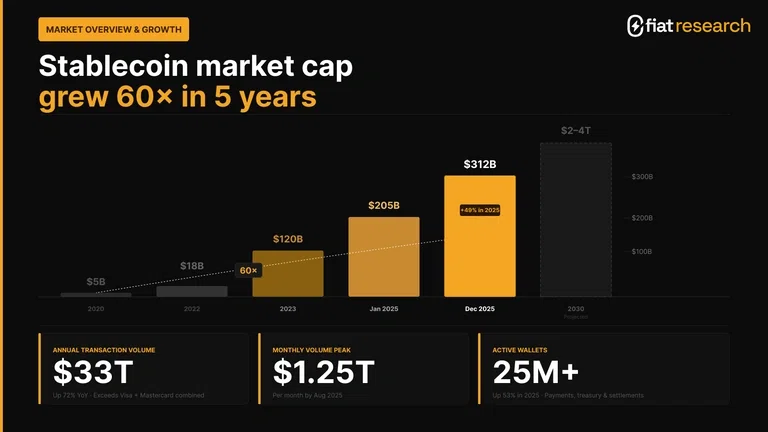
In 2020, the stablecoin market stood at roughly $5 billion. It was a niche tool used primarily within crypto markets to move between positions without touching traditional banking systems. Outside that ecosystem, it was largely ignored. By December 2025, the market had expanded to $312 billion, a 60X increase in just five years.
This growth did not come from speculation. It came from utility. Businesses began settling supplier invoices using stablecoins because it was faster and cheaper than traditional wires. Individuals in high-inflation economies adopted dollar-denominated digital assets as a store of stability.
Corporate treasury teams started treating stablecoins as programmable cash, earning yield while maintaining immediate liquidity.By August 2025, monthly stablecoin transaction volume crossed $1.25 trillion, a level historically associated only with the largest global payment networks.
The forward trajectory is even more telling. Citi projects stablecoin supply could reach $1.9 trillion in a base case and $4 trillion in a high-growth scenario by 2030. EY-Parthenon estimates stablecoins will capture 5 to 10 percent of global cross-border payments within four years.
User adoption reflects the same momentum. Active wallets grew 53 percent in 2025 alone, surpassing 25+ million users. What began as a niche instrument is rapidly becoming core financial infrastructure.
Two Instruments Lead the Market
Any serious discussion of stablecoins quickly converges on two dominant players: USDT and USDC.
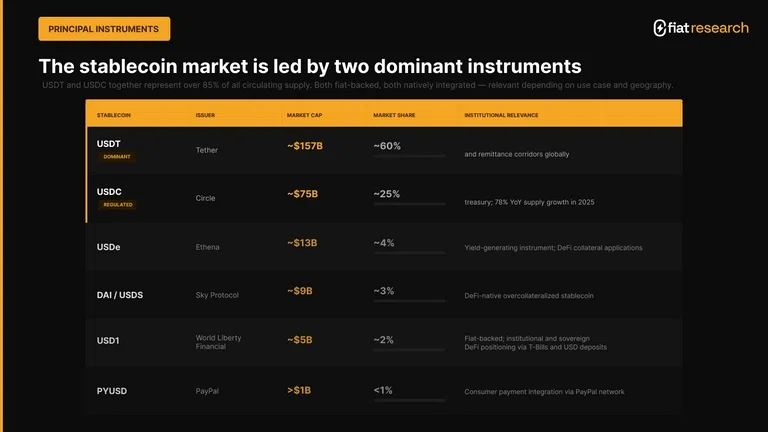
Together, they represent over 85% of total circulating supply, but they occupy distinct roles.
USDT is the dominant liquidity layer. With approximately $157 billion in market cap and around 60% market share, it powers trading activity and remittance flows across emerging markets, including Southeast Asia, Latin America, and Africa. Its strength lies in distribution and accessibility.
USDC, with roughly $75 billion in market cap, serves a different function. It has become the preferred stablecoin for regulated institutions. Its positioning within the traditional financial system is deliberate, and institutional demand reflects that. Its 2025 public market debut drew overwhelming interest, signaling that stablecoins are now viewed as legitimate financial infrastructure rather than experimental technology.
Beyond these two, the ecosystem is expanding with specialized instruments.
USDe from Ethena supports DeFi-native collateral strategies while generating yield. DAI and USDS represent overcollateralized models designed for decentralization and resilience. PayPal’s PYUSD integrates stablecoins into consumer payment flows at scale.
The market is not converging toward a single winner. It is evolving into a layered system where different stablecoins serve different purposes, much like currencies in traditional finance.
Not All Stablecoins Are Created Equal
As adoption accelerates, one distinction has become critical: the structure of reserves.
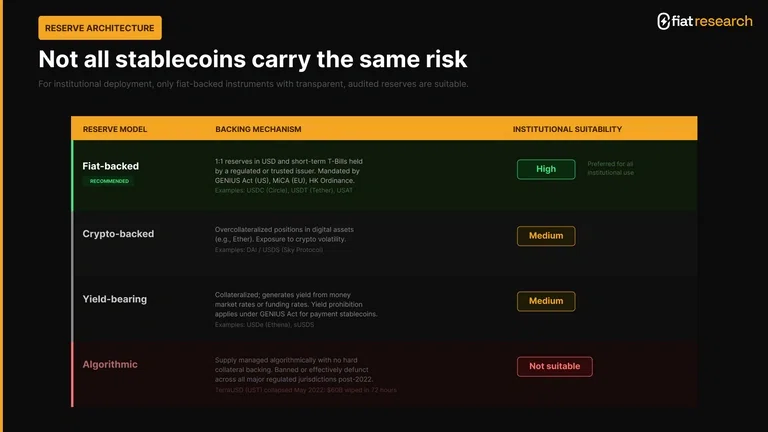
The collapse of TerraUSD in May 2022 made this painfully clear. An algorithmic stablecoin with no hard collateral lost its peg and erased over $60 billion in value within days. The event exposed the fragility of models that rely purely on market confidence. Regulators responded decisively.
Across the United States, Europe, and Asia, frameworks introduced in 2025 established a clear standard: fully reserved, fiat-backed stablecoins are the only acceptable model for regulated use.
These stablecoins maintain a 1:1 backing with cash or short-term government securities held by regulated custodians. This structure gives them credibility as digital dollars rather than speculative instruments.
Other models still exist. Crypto-backed and yield-generating stablecoins offer flexibility and innovation, but they carry additional risk and are suited to more specific use cases.
For institutions in 2026, the decision framework is straightforward. Start with fully backed, transparent, and compliant stablecoins. Treat all other models as secondary tools based on risk tolerance and application.
Cross-Border Payments Are Being Reinvented
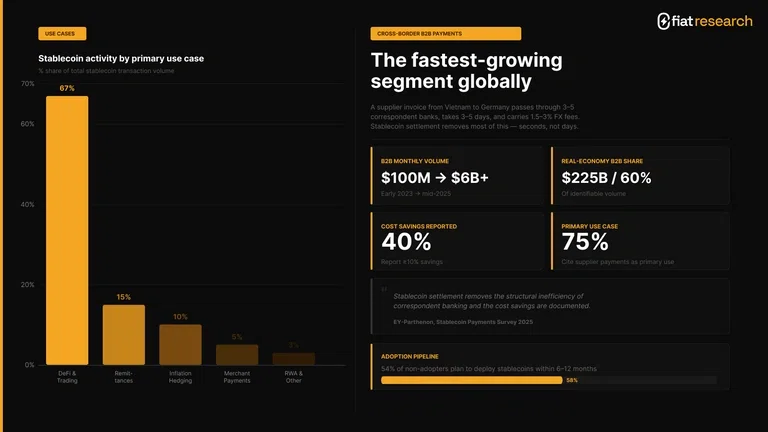
The most immediate and measurable impact of stablecoins is in cross-border payments.
This is where legacy systems are weakest and where the benefits of blockchain based settlement are most visible.
A typical international payment today involves multiple correspondent banks, takes several days to settle, incurs foreign exchange costs of 1.5 to 3 percent, and offers limited transparency. Each intermediary introduces friction. Stablecoins remove most of this complexity.
Transactions settle in seconds. Costs drop to near zero. Every movement is visible in real time. There are no intermediaries because none are required.
Adoption data reflects this shift. B2B stablecoin payment volume grew from under $100 million per month in early 2023 to over $6 billion by mid-2025. That is a 60-fold increase in two years.
According to McKinsey and Artemis Analytics, B2B flows now account for approximately $226 billion, or around 60 percent of all identifiable real-world stablecoin payment activity.
The business impact is tangible. EY-Parthenon reports that 40% of companies using stablecoins have reduced costs by at least 10 percent, primarily in cross-border payments. Additionally, 75 percent cite supplier payments as their primary use case.
This is not experimentation. It is operational change.
Looking ahead, 54% of companies that have not yet adopted stablecoins plan to do so within the next 6 to 12 months. Adoption is no longer gradual. It is accelerating.
Settling the Comparison: Stablecoin vs Legacy Infrastructure
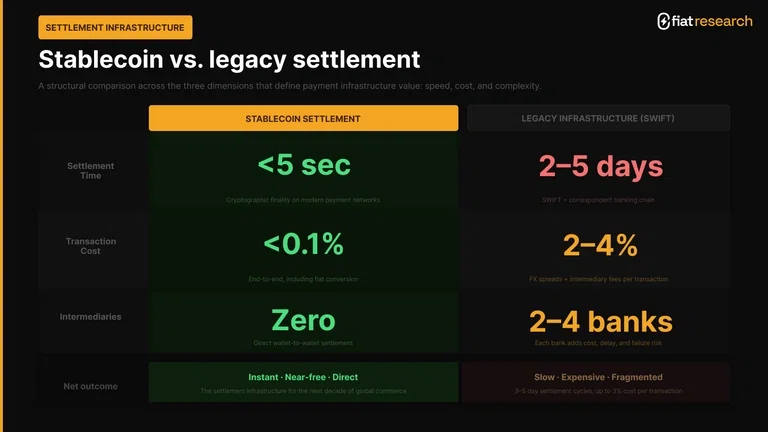
The shift toward stablecoins becomes obvious when comparing them directly with traditional systems.
Settlement time drops from days to seconds. Transaction costs fall from multiple percentage points to near zero. Intermediaries are eliminated entirely.
For finance teams, these are not incremental improvements. They redefine how capital moves.
Stablecoin infrastructure enables instant settlement, continuous liquidity, and direct value transfer. Legacy systems rely on delayed settlement, layered intermediaries, and fragmented visibility. The implication is straightforward.
Organizations that integrate stablecoin rails into their operations will gain a structural advantage in cost, speed, and efficiency. Those that delay will continue operating on infrastructure designed for a pre-internet world.
This transition is not temporary. It is foundational.
The financial system is being rebuilt in real time, and stablecoins are at the center of that transformation.
From Infrastructure to Everyday Spend
The final piece of the stablecoin shift is not just moving money faster. It is making that money usable in everyday life.
This is where products like 0fiat begin to bridge the gap between on-chain value and real-world commerce.
0fiat turns stablecoins from a settlement layer into a spending layer. Instead of converting crypto back into fiat through banks or cards, users can pay directly at checkout across global merchants using USDT or USDC and zero transaction fees.
The experience is structurally different from traditional crypto cards. There is no issuance, no intermediaries holding funds, and no delay between ownership and usability. Payments are executed directly from a self-custodial wallet, meaning the user retains control until the moment of transaction approval.
What this represents is a natural extension of the stablecoin thesis.
If stablecoins are redefining how money moves, platforms like 0fiat are redefining how money is spent.
Data and Information Sources: Decrypt, Stablecoin Insider, Artemis Analytics, Bloomberg, Citi, CoinGecko, McKinsey & Company, EY-Parthenon and Morph
Note: Information shared in the analysis above does not constitute financial advice for stablecoins or crypto investments. Readers are advised to consult their own financial representatives.