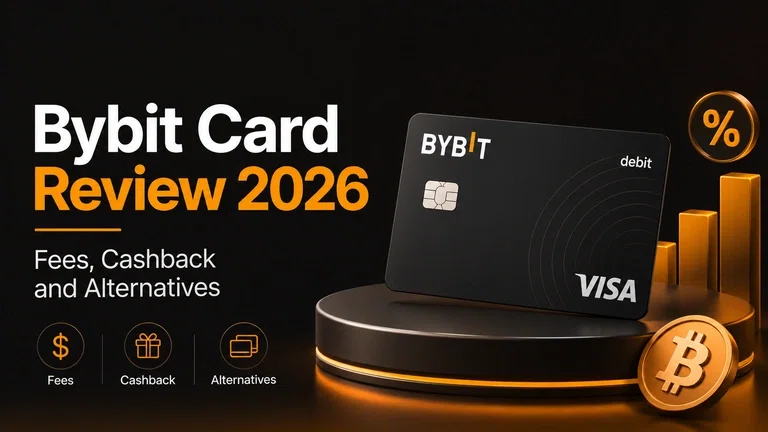
The Bybit Card is one of the better known crypto cards for users who want to spend digital assets through a traditional card network. It combines crypto spending with Mastercard acceptance, allowing eligible users to use supported assets for everyday purchases.
But how much does the Bybit Card actually cost in 2026? How does Bybit Card cashback work, and is there a better option for users who prefer to keep their crypto in self custody?
This Bybit Card review covers the card, its fees, cashback, advantages, limitations and 0fiat as an alternative way to spend crypto.
Bybit Card Explained
The Bybit Card is a crypto debit card that allows eligible users to spend supported digital assets at merchants that accept Mastercard.
Instead of manually selling crypto and withdrawing fiat before making a purchase, users can use supported assets through their Bybit account for eligible card transactions.
The card is available in selected regions and can come in virtual and physical versions depending on the market.
In 2026, Bybit advertises 2% to 10% cashback on everyday spending depending on the applicable reward tier. It also has no annual fee and supports spending with crypto or cash.
The important thing to understand is that the Bybit Card is closely connected to the Bybit ecosystem. Users generally keep their spending assets within their Bybit account rather than connecting an external self custody wallet directly to the card.
That makes it convenient for existing Bybit users, but it also makes it different from payment solutions that allow users to spend directly from their own wallets.
How the Bybit Crypto Card Works
The Bybit crypto card essentially creates a bridge between crypto holdings and traditional card payments.
The basic process is:
Create and verify a Bybit account.
Apply for the Bybit Card if it is available in your region.
Fund your Bybit account with supported assets.
Use the virtual or physical card for eligible purchases.
Bybit handles the conversion required for the transaction.
This gives users a familiar card payment experience.
You can use the card at merchants that accept Mastercard rather than needing the merchant to directly accept cryptocurrency.
The card supports a range of crypto assets, with the exact supported assets depending on the market and card program.
For someone who already trades and holds crypto on Bybit, this can remove some of the friction involved in turning crypto into spendable money.
The tradeoff is that the user is relying on an exchange based payment system rather than spending directly from a self custody wallet.
Bybit Card Fees
One of the most important parts of any Bybit Card review is understanding what you actually pay when using the card.
The Bybit Card has no annual fee, but that does not mean every transaction is free. Crypto conversion, ATM withdrawals and other transaction related costs can apply depending on the user's region.
Spend USDT and USDC With Zero 0fiat Transaction Fees
The current fee structure includes the following examples:
Fee Type | Current Example |
Annual fee | $0 |
Crypto conversion fee | Up to 0.9% depending on region |
ATM withdrawal | 2% after the applicable free allowance |
Monthly ATM free allowance | 100 EUR in the example listed by Bybit |
Foreign transaction fee | Depends on the applicable card program |
Physical card fee | Varies by region |
The important takeaway is that $0 annual fee does not mean zero fees overall.
Crypto Conversion Fees
Crypto conversion is particularly important if you are spending crypto rather than fiat.
Bybit's current fee information gives an example of a 0.9% crypto conversion fee.
For a simple $100 equivalent purchase, a 0.9% conversion fee would be:
Purchase: $100
Conversion fee: $0.90
Total: Approximately $100.90 before any exchange rate differences
The actual amount can vary depending on the applicable conversion rate and the user's region.
This makes the conversion fee one of the most important numbers to consider when comparing the Bybit Card with other ways to spend crypto.
ATM Withdrawal Fees
The Bybit Card also supports ATM withdrawals in applicable markets.
The current fee structure gives an example of a 2% ATM withdrawal fee after the first 100 EUR of monthly withdrawals.
For example, imagine you have already used your monthly free allowance and withdraw another 200 EUR.
At a 2% fee:
Withdrawal: 200 EUR
ATM fee: 4 EUR
Total fee: 4 EUR
The ATM operator may also charge its own fee, meaning the total cost could be higher.
Foreign Exchange Costs
Foreign currency spending is another area worth checking.
The exact foreign exchange treatment can depend on the card program and region. Some current Bybit Card programs advertise 0% foreign transaction fees, while other regional fee structures can have different currency conversion costs.
This is particularly relevant for people who use the card while travelling.
Rather than assuming that every Bybit Card user has the same FX costs, it is better to check the terms applicable to the specific country where the card was issued.
Bybit Card Cashback
Bybit Card cashback is one of the card's biggest selling points.
The current rewards program offers 2% to 10% cashback depending on the user's reward tier.
There are six reward tiers, with higher tiers providing higher cashback rates.
This means the advertised 10% figure should not be interpreted as the standard rate every user receives.
Your actual Bybit Card cashback depends on your applicable tier, eligible purchases and the current reward rules.
How Much Bybit Card Cashback Can You Earn?
At the lower end of the current reward structure, users can earn 2% cashback on eligible spending.
At the highest tier, the rate can reach 10%.
For example:
Spending | 2% Cashback | 5% Cashback | 10% Cashback |
$1,000 | $20 | $50 | $100 |
These are simple illustrations of the percentage rates and do not mean every transaction will qualify for the maximum rate.
There can also be reward limits, exclusions and eligibility requirements.
Subscription Cashback
Another interesting part of the current Bybit rewards program is cashback on selected subscriptions.
Eligible users at certain reward tiers can receive 100% cashback on selected subscriptions, subject to the applicable monthly limits.
Supported examples include services such as Netflix, Spotify, ChatGPT and TradingView.
This can be useful for users who already pay for several digital subscriptions every month.
However, it is important to distinguish these promotional or category specific rewards from the standard cashback rate on everyday spending.
Bybit Card Pros and Cons
A good crypto card should look beyond the cashback number too. Here is a comprehensive advantages and disadvantages, summarized:
Advantages of the Bybit Card
2% to 10% cashback depending on reward tier
$0 annual fee
Virtual and physical card options
Mastercard acceptance
Ability to spend supported crypto
Useful for existing Bybit users
Cashback opportunities on selected subscriptions
Familiar card payment experience
No need to manually sell crypto before every purchase
Limitations of the Bybit Card
Availability varies by country
Requires a Bybit account
Verification requirements apply
Crypto conversion fees can apply
ATM withdrawals can incur a 2% fee after the applicable allowance
Cashback depends on reward tier and eligible transactions
The card is tied to the Bybit ecosystem
Users who prefer self custody cannot directly connect their personal wallet to the card for normal card spending
That last point is particularly important.
A crypto card and direct crypto spending are not the same thing.
Is the Bybit Card Worth It in 2026?
For existing Bybit users, the card can make a lot of sense.
If your crypto is already held on Bybit and you want to spend it through a familiar Mastercard payment experience, the Bybit Card removes several steps.
The cashback program can also be attractive if you qualify for a higher reward tier or regularly use eligible subscription services.
However, the card is less compelling for users whose priority is self custody.
If your USDT or USDC is sitting in your own wallet, you may not want to transfer it to an exchange simply to spend it.
This creates an additional step and changes how you manage your crypto.
This is where a Bybit Card alternative such as 0fiat can offer a different approach.
Explore 0fiat as a Bybit Card Alternative
Bybit Card Alternative: 0fiat
0fiat takes a different approach to crypto payments.
Instead of issuing another crypto card, 0fiat allows users to pay at supported online stores directly from their own crypto wallet.
You can use supported USDT and USDC and approve the payment from your wallet rather than first moving the funds into a card account.
Pay With Crypto Using 0fiat
Your crypto remains in your wallet until you actually make a payment.
There is no card issuance process and no annual card fee. 0fiat also charges zero transaction fees.
For users who value self custody, this is a fundamentally different model from a traditional crypto card.
Instead of asking which crypto card to use, the approach is much simpler: keep your crypto in your wallet and use it directly when making a purchase.
Bybit Card vs 0fiat
The two options are designed around different spending experiences.
Feature | Bybit Card | 0fiat |
Payment model | Crypto card | Direct wallet checkout |
Card required | Yes | No |
Self custody | No | Yes |
Account | Bybit account | Compatible crypto wallet |
KYC | Bybit verification required | No KYC |
Crypto | Multiple supported assets | USDT and USDC |
Annual fee | $0 | $0 |
Platform transaction fee | Transaction dependent | $0 |
Cashback | 2% to 10% depending on tier | Not a card cashback model |
Physical card | Available in supported markets | No |
Online shopping | Yes | Yes, at supported stores |
Mastercard acceptance | Yes | No card network required |
Best suited for | Card based crypto spending | Direct wallet based crypto spending |
The biggest advantage of the Bybit Card is merchant flexibility.
Because it operates through Mastercard, it can be used at a much broader range of merchants than a platform limited to a specific group of online stores.
0fiat's advantage is the opposite.
It does not require users to move crypto into an exchange or use a card. You keep control of your assets and pay directly from your wallet.
For someone who already uses self custody and primarily shops online, that can be a simpler approach.
Which Crypto Spending Option Is Better?
There is no universal winner because the two products solve different problems.
The Bybit Card is better suited to someone who wants a traditional card experience.
You get a physical or virtual card, Mastercard acceptance and a rewards program that can provide meaningful cashback for eligible users.
It is particularly useful if you already use Bybit and keep your crypto there.
0fiat is better suited to users who want to maintain self custody and spend directly from their wallet.
There is no need to apply for a card, transfer crypto to an exchange or maintain a separate card balance.
The tradeoff is merchant coverage. 0fiat works through supported online stores, while the Bybit Card can be used wherever the applicable Mastercard is accepted.
So the choice comes down to what matters more:
Want a traditional crypto card with cashback? The Bybit Card may be the better fit.
Want to pay directly from your own wallet? 0fiat offers a more self custody focused alternative.
Conclusion
The Bybit Card remains a strong option for crypto users who want to combine their digital assets with everyday card spending.
Its main strengths are broad card acceptance, a $0 annual fee, virtual and physical card options and a rewards program offering 2% to 10% cashback depending on the applicable tier.
However, the headline numbers do not tell the entire story.
Bybit Card fees can include crypto conversion and ATM charges depending on the transaction and region. For example, a 0.9% conversion fee would add $0.90 to a $100 crypto conversion, while a 2% ATM fee would cost $4 on a $200 withdrawal after the applicable free allowance.
For existing Bybit users, these costs may be worth paying for the convenience and rewards.
For users who prefer self custody, however, a different approach can make more sense.
As a Bybit Card alternative, 0fiat lets users spend USDT and USDC directly from their own wallet at supported online stores without requiring a crypto card.
Ultimately, the decision comes down to what matters more: card based convenience and cashback, or direct wallet based crypto spending and self custody.
Frequently Asked Questions (FAQs)
What is the Bybit Card?
The Bybit Card is a crypto debit card that allows eligible users to spend supported digital assets through a Mastercard based payment system.
What are the Bybit Card fees?
The Bybit Card has a $0 annual fee, but crypto conversion and ATM fees can apply depending on the region and transaction.
How much Bybit Card cashback can I earn?
The current rewards program offers 2% to 10% cashback depending on the applicable reward tier and eligible spending.
Does the Bybit Card have a crypto conversion fee?
Yes. The fee can vary by region, with 0.9% currently applicable in certain markets.
Is the Bybit Card available worldwide?
No. Availability and features depend on the user's country and local regulations.
What is a Bybit Card alternative?
0fiat is an alternative for users who want to spend USDT or USDC directly from a self custody wallet at supported online stores without using a crypto card.
Does 0fiat require a card?
No. 0fiat allows users to pay directly from supported crypto wallets at supported online stores.