
Bitcoin is often described as having a fixed supply of 21 million coins. But that number does not tell the whole story.
More than 20 million BTC have already been mined, millions are estimated to be permanently lost, and a growing share is held by businesses, ETFs, governments and other large investors. So how much Bitcoin is actually available to the market today, and who owns the rest?
Bitcoin's 21 Million Supply Cap
Bitcoin was designed with a maximum supply of approximately 21 million BTC.
Unlike fiat currencies, where the supply can be expanded by central banks and governments, Bitcoin's issuance is controlled by its protocol. New BTC are created as rewards for miners that validate transactions and secure the network.
The important word here is maximum.
There will never be 21 million freely circulating Bitcoin available for people to buy and sell. Some BTC have already been lost, some are held for very long periods, and some are effectively locked in addresses or systems where they rarely move.
That makes Bitcoin's real-world supply much more interesting than the simple 21 million figure.
How Much Bitcoin Has Been Mined?
As of August 2026, approximately 20.06 million BTC have been mined.
That represents roughly 95.5% of Bitcoin's eventual supply.
In other words, Bitcoin has already crossed the point where more than 19 out of every 20 coins that will ever exist have been issued.
The current Bitcoin block subsidy is 3.125 BTC. New blocks are added approximately every 10 minutes, although the actual timing varies.
The amount of new Bitcoin entering circulation is therefore relatively small compared with the amount that has already been created.
This is one of the reasons Bitcoin's supply schedule is so different from traditional currencies. New supply does not suddenly increase because demand rises. It follows a predetermined issuance schedule.
How Much Bitcoin Is Left to Mine?
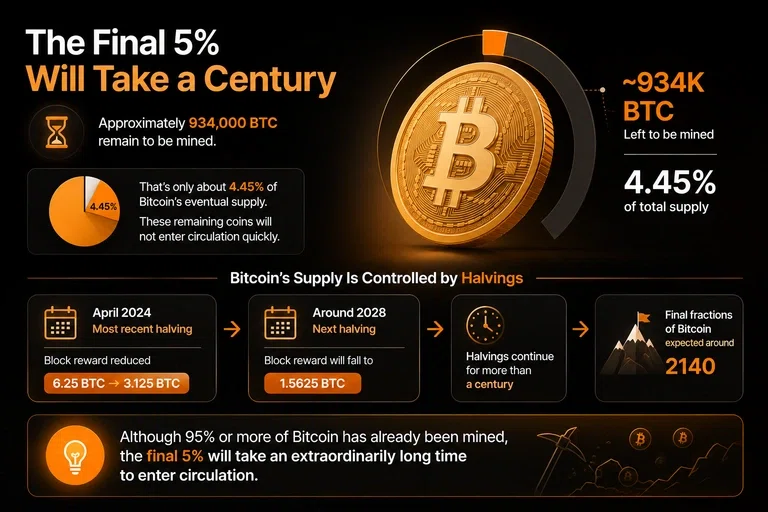
Approximately 934,000 BTC remain to be mined.
That sounds like a large number, but it represents only about 4.45% of Bitcoin's eventual supply.
And these remaining coins will not enter circulation quickly.
Bitcoin's block reward is cut approximately every four years through an event known as the halving. The most recent halving occurred in April 2024, reducing the reward from 6.25 BTC to 3.125 BTC per block.
The next halving is expected around 2028, when the reward will fall to 1.5625 BTC.
This process continues for more than a century.
The final fractions of Bitcoin are expected to be mined around 2140.
So although 95% or more of Bitcoin has already been mined, the final 5% will take an extraordinarily long time to enter circulation.
How Much Bitcoin Is Considered Lost?
This is where Bitcoin's supply story gets more interesting.
Nobody knows exactly how much Bitcoin is permanently lost.
Bitcoin does not have a "lost coin" flag. If someone loses their private keys, the blockchain cannot tell us whether the coins are lost forever or simply being held by someone who has not moved them for years.
Researchers therefore use different methods to estimate lost Bitcoin.
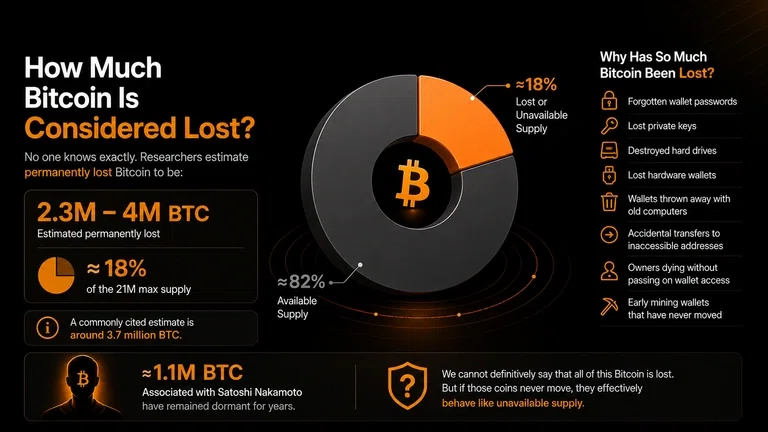
Current estimates generally put permanently lost Bitcoin somewhere around 2.3 million to 4 million BTC.
A commonly cited estimate is around 3.7 million BTC.
That would represent roughly 18% of the 21 million maximum supply.
But it is important not to treat this as an exact number.
Some dormant Bitcoin could eventually move. A wallet that has been untouched for 12 years is not necessarily a lost wallet. The owner may simply be holding it.
Why Has So Much Bitcoin Been Lost?
Bitcoin's early years provide much of the explanation.
The asset was worth very little compared with today, and many early users did not treat their private keys with the same level of care that modern investors do.
Lost Bitcoin can come from:
Forgotten wallet passwords
Lost private keys
Destroyed hard drives
Lost hardware wallets
Wallets thrown away with old computers
Accidental transfers to inaccessible addresses
Owners dying without passing on wallet access
Early mining wallets that have never moved
The most famous example is the Bitcoin associated with Satoshi Nakamoto.
Around 1.1 million BTC are commonly attributed to wallets believed to be associated with Bitcoin's creator. Those coins have remained dormant for years.
We cannot definitively say that all of this Bitcoin is lost. But if those coins never move, they effectively behave like unavailable supply.
How Much Bitcoin Is Actually Available?
This is where the headline figure of 21 million becomes misleading.
Imagine Bitcoin eventually reaches its full 21 million supply.
If approximately 3 million BTC are permanently lost, then the economically available supply would be closer to 18 million BTC.
That does not mean only 18 million BTC can technically exist. It means approximately 3 million coins would no longer be realistically available to buyers or sellers.
The same idea applies today.
Around 20.06 million BTC have been mined, but not all of those coins are actively circulating.
Some are:
Permanently lost
Held by long-term investors
Held by companies
Held by ETFs and funds
Held by governments
Held by miners
Held in exchange reserves
Locked in various protocols
Held in dormant wallets
This is why analysts increasingly focus on liquid supply, rather than simply looking at the total number of Bitcoin that have been mined.
Who Owns Bitcoin Today?
Bitcoin ownership is much more distributed than it might appear.
Retail investors still control the largest share of Bitcoin, even as institutional ownership has grown significantly.
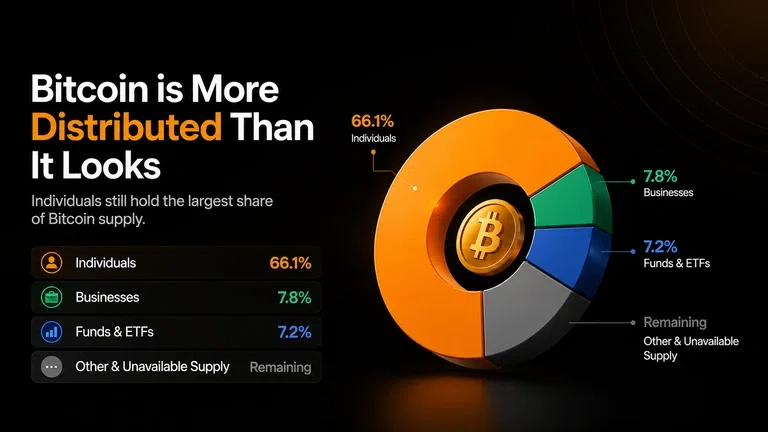
One of the most recent comprehensive ownership estimates puts individuals at approximately 66.1% of the total Bitcoin supply.
That is a remarkable figure.
Despite the growth of Bitcoin ETFs, corporate Bitcoin treasuries and government holdings, individuals still account for roughly two-thirds of the overall supply according to this estimate.
The same research estimates:
Holder category | Approx. share of total Bitcoin supply |
Individuals | 66.1% |
Businesses | 7.8% |
Funds and ETFs | 7.2% |
Other categories and unavailable supply | Remaining supply |
These numbers should be viewed as estimates rather than a perfect blockchain census.
That is because Bitcoin addresses do not come with labels saying "retail investor", "hedge fund" or "family office". Researchers have to identify addresses, analyze ownership patterns and combine blockchain data with public disclosures.
Retail Investors vs Institutions
The idea that Wall Street now owns most of Bitcoin is not supported by the broader ownership estimates.
Retail and individual holders still control the majority.
But institutional ownership is growing rapidly.
Retail investors
Retail investors include individuals holding Bitcoin through:
Self-custody wallets
Exchanges
Smaller investment accounts
Long-term personal holdings
Trading accounts
Their holdings can range from a tiny fraction of a Bitcoin to hundreds or thousands of BTC.
The interesting thing about Bitcoin is that you do not need to own one whole BTC to participate. A Bitcoin can be divided into 100 million satoshis, making the asset accessible to people buying very small amounts.
ETFs and funds
Bitcoin ETFs have created an entirely new ownership category.
Instead of buying and storing Bitcoin themselves, investors can buy shares in an investment vehicle that holds Bitcoin on their behalf.
This means the Bitcoin may technically sit in a small number of institutional custody addresses, while economically it belongs to thousands or millions of investors.
That creates an important distinction.
Address concentration does not necessarily equal ownership concentration.
One ETF wallet could contain hundreds of thousands of BTC while representing the interests of a huge number of individual investors.
Businesses
Companies have also become significant Bitcoin holders.
Some businesses hold Bitcoin as a treasury asset, while others have made Bitcoin accumulation a central part of their corporate strategy.
By mid 2026, tracked public and private companies collectively held well over 1.5 million BTC across various corporate treasury categories.
This represents a significant portion of Bitcoin's total supply.
Governments
Governments also hold Bitcoin.
Government holdings generally come from seizures, criminal investigations, asset forfeitures or other government operations rather than ordinary market purchases.
The exact amount changes over time as governments sell, acquire or transfer Bitcoin.
Estimates in 2026 put government holdings at hundreds of thousands of BTC globally.
Miners
Bitcoin miners are another important category.
Miners receive newly issued Bitcoin and can either sell it to cover operating costs or hold it as part of their treasury.
Miner holdings can therefore influence the amount of BTC entering the market, particularly when mining companies need liquidity.
Bitcoin Whales and Small Holders
Another way to understand Bitcoin distribution is by looking at wallet or entity sizes.
On-chain data shows an interesting pattern.
The smallest Bitcoin holders collectively own a relatively small share of the supply, while large entities control a substantial amount.
Recent Glassnode data shows that entities holding between 0.1 and 1 BTC account for roughly 5.3% of circulating supply, while entities holding 1 to 10 BTC account for around 10.1%.
The larger categories become increasingly significant.
Entities holding:
10 to 100 BTC: around 15.5%
100 to 1,000 BTC: around 18.0%
1,000 to 10,000 BTC: around 12.6%
10,000 to 100,000 BTC: around 8.0%
More than 100,000 BTC: around 28.8%
But there is an important catch.
These are entity-level on-chain categories, not necessarily individual investors.
An exchange, ETF custodian or institutional custodian can control a wallet containing tens of thousands of BTC while representing thousands or millions of underlying customers.
So saying "whales own 28.8% of Bitcoin" would be misleading.
The blockchain tells us where coins are held. It does not always tell us who economically owns them.
Why Bitcoin's Supply Distribution Matters
Bitcoin's supply distribution matters because price is determined at the margin.
You do not need every Bitcoin to be available for sale for the price to move.
If millions of BTC are held by people who have no interest in selling, the amount of Bitcoin actually available to buyers can be much smaller than the headline circulating supply suggests.
This is especially important when demand increases.
Imagine:
20 million BTC have been mined.
Several million are permanently lost.
Millions more are held by long-term investors.
ETFs and companies continue accumulating.
Retail investors continue buying smaller amounts.
The number of Bitcoin technically in existence does not change much, but the amount available for immediate sale can become increasingly limited.
This is one reason Bitcoin's fixed supply narrative is about more than simply saying "there will only ever be 21 million."
The more important question is:
How much Bitcoin is actually available for someone to buy today?
The Bitcoin Supply Picture in 2026
Putting everything together gives us a much clearer picture.
Approximately 20.06 million BTC have been mined
More than 95% of Bitcoin's eventual supply has already been issued.
Approximately 934,000 BTC remain
The remaining supply will be released extremely slowly through future mining rewards and halvings.
Roughly 2.3 to 4 million BTC may be permanently lost
The exact figure is unknown, but several independent estimates put lost Bitcoin in this broad range.
Individuals still own the majority
Recent estimates put individual ownership at around 66% of the total supply.
Institutions are becoming increasingly important
Funds, ETFs, companies and governments collectively control a growing share of Bitcoin.
The liquid supply is much smaller than 21 million
A significant amount of Bitcoin is either lost, dormant, strategically held or sitting with entities that do not frequently trade it.
That is arguably the most important takeaway from Bitcoin's supply structure.
What Happens When All Bitcoin Is Mined?
The last Bitcoin is expected to be mined around 2140.
But that does not mean the Bitcoin network stops working.
Bitcoin miners currently receive two types of compensation:
Block subsidies
Transaction fees
Today, the block subsidy is the dominant component for many miners.
After the final Bitcoin is issued, there will be no new BTC subsidy.
Miners will instead depend entirely on transaction fees paid by users.
The Bitcoin network will continue processing transactions. The monetary policy simply reaches its final stage.
There will also still be movement between existing holders.
People will buy Bitcoin, sell it, transfer it, lose it and potentially recover old wallets. The total supply will simply stop growing.
Conclusion
Bitcoin's famous 21 million supply cap is only the starting point.
More than 20 million BTC have already been mined, leaving less than 1 million to be issued. At the same time, millions of Bitcoin are estimated to be permanently lost, while millions more are held by long-term investors, companies, ETFs, governments and other entities.
Retail investors remain the largest ownership group, accounting for roughly two-thirds of Bitcoin's total supply in recent estimates. But institutional ownership has grown considerably, particularly through ETFs and corporate treasury strategies.
The result is a Bitcoin market where the 21 million maximum supply is very different from the amount of BTC that is actually available to trade.
And with less than 5% of the eventual supply left to mine, Bitcoin's future supply story is increasingly going to be about who holds the existing coins, who is willing to sell them and how much of the supply remains liquid.
References
Bitcoin Total Circulating Supply: Blockchain.com Bitcoin Supply Chart
Bitcoin Supply and Remaining BTC: ChainQuery Bitcoin Supply Report
Bitcoin Lost Supply Estimates: BitGo: How Many Bitcoins Are Lost?
Bitcoin Ownership Distribution, Individual vs Businesses vs Funds/ETFs: Bitwise ownership data reported by Bitcoin.com
Bitcoin Halving and Issuance Schedule: CoinGecko Bitcoin Halving Schedule
Bitcoin Protocol and 21 Million Supply: Bitcoin Core source code
Frequently Asked Questions (FAQs)
How many Bitcoin have been mined in 2026?
Approximately 20.06 million BTC have been mined as of August 2026, or roughly 95.5% of Bitcoin's eventual supply.
How many Bitcoin are left to mine?
Approximately 934,000 BTC remain to be mined. New Bitcoin will continue to be issued through mining rewards until around 2140.
How many Bitcoin are considered lost?
Estimates generally range from around 2.3 million to 4 million BTC. A commonly cited estimate is approximately 3.7 million BTC, but there is no exact figure.
Who owns most of the Bitcoin?
Individuals and retail investors still appear to control the largest share, with recent estimates putting individual ownership at around 66% of total supply.
How much Bitcoin do institutions own?
The exact figure depends on how institutions are defined, but ETFs, public and private companies, governments and other institutional entities collectively hold several million BTC. Their share has increased significantly in recent years.
Will all 21 million Bitcoin ever be available to buy?
No. Some Bitcoin has likely been permanently lost, while other coins may remain dormant or be held for very long periods. The amount of BTC actually available for trading is therefore much lower than the theoretical 21 million supply.