Accepting crypto at checkout is no longer a niche feature. Stablecoin payment volume topped $28 trillion in 2025, and merchants from independent retailers to enterprise platforms are looking at crypto as a payment rail. The infrastructure for getting there is the payment gateway: the layer that sits between a customer's wallet and a merchant's bank account (or crypto wallet).
The problem is that the options look similar on the surface. Most list the same coins, offer some form of fiat settlement, and charge fees somewhere between 0% and 2%. The real differences come down to custody model, settlement speed, which stablecoins are supported, and whether the platform fits a small merchant or an enterprise.
This guide covers what a crypto payment gateway actually is, how it differs from a fiat-to-crypto gateway, what to look for before choosing one, and a comparison of the five strongest options currently available.
What Is a Crypto Payment Gateway?
A crypto payment gateway is software that lets a merchant accept cryptocurrency from a customer, verify the transaction on-chain, and optionally convert the received crypto into fiat currency before depositing it to the merchant's bank account. The merchant gets paid; the customer pays in crypto.
The gateway handles the exchange-rate lock at the moment of purchase, the blockchain confirmation, and the settlement, whether that lands as BTC in a wallet or USD in a bank depends on the merchant's configuration.
How a Crypto Payment Gateway Works
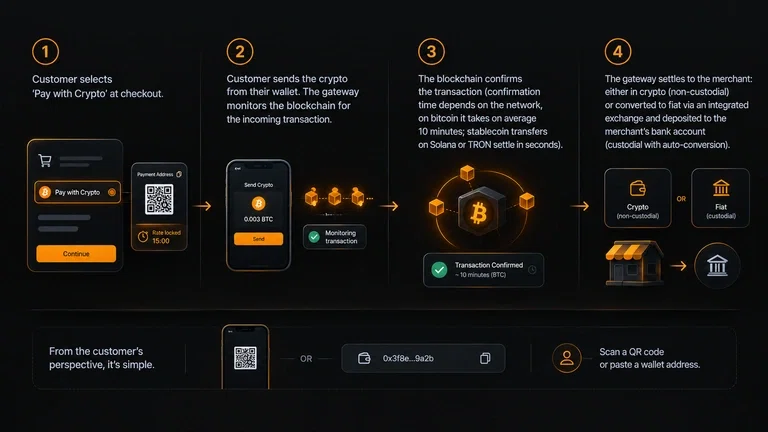
The transaction flow has four stages:
The customer selects 'Pay with Crypto' at checkout. The gateway generates a payment address and locks the exchange rate for a short window which is typically between 15 to 30 minutes.
Customers send the crypto from their wallet. The gateway monitors the blockchain for the incoming transaction.
The blockchain confirms the transaction (confirmation time depends on the network, on bitcoin it takes on average 10 minutes; stablecoin transfers on Solana or TRON settle in seconds).
The gateway settles to the merchant: either in crypto (non-custodial) or converted to fiat via an integrated exchange and deposited to the merchant's bank account (custodial with auto-conversion).
This process is largely invisible to the end customer. From their side, they scan a QR code or paste a wallet address.
Custodial vs. Non-Custodial Gateways
This distinction matters more than most comparison articles acknowledge.
Custodial gateways hold merchant funds during the settlement process. The gateway converts crypto to fiat and wires the balance to the merchant's bank account, which is typically daily or weekly. The merchant never touches crypto directly. BitPay and Triple-A operate this way.
Non-custodial gateways send crypto directly to the merchant's wallet. No third party holds the funds at any point. BTCPay Server is the clearest example: it is self-hosted software with no custody layer. The merchant takes on exchange-rate risk unless they convert manually or route through a stablecoin.
For merchants who want simplicity and fiat in their bank account, custodial is easier. For merchants who want full control and are comfortable with crypto operations, non-custodial removes counterparty risk.
Crypto Payment Gateway vs. Fiat-to-Crypto Gateway
A crypto payment gateway moves money from a customer's wallet to a merchant. A fiat-to-crypto gateway (also called an on-ramp) moves money in the other direction: a user pays in fiat (credit card, bank transfer) and receives crypto. These are different products serving different use cases.
Which Type Does a Merchant Need?
Use Case | Product Type | Examples |
|---|---|---|
Accept crypto from customers at checkout | Crypto payment gateway | BitPay, NOWPayments, CoinGate |
Let users fund accounts by buying crypto with a bank card | Fiat-to-crypto on-ramp | MoonPay, Transak, , Onramp Money |
Convert received crypto to fiat and deposit to bank | Custodial gateway with auto-conversion | BitPay, Triple-A, Coinbase Commerce |
Accept stablecoins directly, no fiat conversion needed | Non-custodial or stablecoin-native gateway | 0fiat, BTCPay Server, Sphere |
A merchant selling physical goods who wants crypto payments converted to USD needs a custodial crypto payment gateway. A DeFi platform that wants users to fund wallets using credit cards needs a fiat on-ramp. Conflating the two leads to buying the wrong product.
What to Look for in a Crypto Payment Gateway
Before evaluating individual vendors, clarify what your business actually needs. These are the criteria that determine whether a gateway fits.
Supported Coins and Stablecoins
Bitcoin and Ethereum are table stakes. The meaningful differentiator is stablecoin support, specifically USDT and USDC, which together account for the majority of stablecoin transaction volume.
USDT runs on multiple networks: Ethereum (ERC-20), TRON (TRC-20), Solana, and BSC. Fees and confirmation times vary significantly by network, TRC-20 USDT typically settles in seconds for under $1 in fees; ERC-20 USDT can cost several dollars during high-congestion periods. Check whether the gateway supports the specific network, not just the token.
For merchants targeting international customers, also consider whether the gateway accepts local stablecoins or regional coins with significant adoption in specific markets.
Fees and Settlement Speed
Most gateway fees fall into three buckets: transaction processing fee, conversion/exchange fee (if auto-converting to fiat), and withdrawal or payout fee. Not all platforms disclose all three prominently.
Processing fees typically run between 0.5% and 1% for established gateways. Add the exchange fee if you are auto-converting, this can be another 0.5% to 1.5% depending on the platform's liquidity arrangements. Total cost-per-transaction can therefore reach 2% to 2.5% before any bank wire fees.
Settlement speed ranges from same-day (some custodial gateways) to 2–3 business days for traditional bank payouts. For merchants with tight cash-flow requirements, settlement timing is not a minor detail.
Fiat Settlement and Auto-Conversion Options
Custodial gateways with fiat settlement protect merchants from price volatility. The gateway locks the rate at the time of purchase, converts to fiat, and deposits on a schedule. The downside is that the merchant is trusting the gateway's exchange rate, which may be worse than spot.
Non-custodial gateways that settle in stablecoins (USDT, USDC) offer a middle path: no fiat conversion needed, no counterparty custody risk, and near-zero volatility since the asset is pegged to USD. For merchants comfortable operating in stablecoins, this is often the lower-cost option.
Security, Compliance, and KYC/AML
Custodial gateways operating in regulated jurisdictions, the US, EU, UK are subject to AML/KYC requirements and typically require merchant onboarding (business verification, sometimes individual verification of beneficial owners). Expect a review process before going live.
Non-custodial gateways like BTCPay Server require no merchant registration. The compliance burden falls on the merchant directly if they operate in a regulated space.
Stablecoin issuers (Tether for USDT, Circle for USDC) maintain their own compliance programmes and reserve audits, but a gateway's security posture, how it stores keys, whether it has been audited, whether it holds funds at any point, should be independently reviewed.
Integration Options
Most gateways offer a payment API for custom integrations, plus pre-built plugins for WooCommerce, Shopify, Magento, and similar platforms. Enterprise gateways add hosted payment pages, invoice generation, and webhook support for order management systems.
For non-technical merchants, the quality of the no-code tools, payment links, checkout buttons, hosted pages, matters more than API sophistication. For developers, evaluate the API documentation and sandbox environment before committing.
The 5 Best Crypto Payment Gateways in 2026
The following shortlist covers the platforms with the clearest differentiation. Rather than ranking by size or brand recognition, each entry holds a specific position that a different gateway does not cover as well.
Note: Fees and coin lists change frequently in this category. Verify current pricing on each vendor's pricing page before committing. All figures below are based on publicly available data as of September 2026.
Gateway | Fees | Stablecoins | Fiat Settlement | Custody Model | Best Fit |
|---|---|---|---|---|---|
BitPay | 1% per transaction | USDT, USDC, BUSD | Yes — USD, EUR, GBP | Custodial | Established merchants needing fiat payout |
NOWPayments | 0.5% + network fee | USDT, USDC, DAI + more | Yes (via exchange) | Custodial option | High coin-variety needs |
CoinGate | 1% per transaction | USDT, USDC, USDT TRC-20 | Yes — SEPA/SWIFT | Custodial | European merchants, invoicing |
BTCPay Server | Zero (self-hosted) | USDT, USDC via plugins | None (crypto only) | Non-custodial | Tech-comfortable merchants, full control |
0fiat | Zero | USDT, USDC (SOL, TRC-20, BSC) | None — stablecoin settlement | Non-custodial | Zero-fee stablecoin checkout, no KYC |
1. BitPay: Best for Established Merchants Who Need Fiat Payouts
BitPay has been operating since 2011 and is one of the few crypto payment gateways with a track record long enough to evaluate independently. It processes payments in BTC, ETH, several stablecoins (USDT, USDC, BUSD), and a handful of altcoins, then converts and settles in USD, EUR, or GBP via bank transfer.
Fees: 1% per transaction. Fiat settlement is included; withdrawal fees may apply depending on bank and region.
Settlement: Daily to merchant bank accounts. The exchange-rate lock happens at checkout, protecting merchants from volatility between payment and payout.
Integration: API, WooCommerce, Shopify, Magento plugins, hosted checkout pages, payment links, and a BitPay ID onboarding flow for consumers.
Compliance: US-regulated, subject to FinCEN Money Services Business registration. Merchant onboarding requires business verification.
The limitation is geographic, full fiat settlement is best supported in the US and Western Europe. Merchants in other regions may find settlement options more restricted. The 1% fee is also not the lowest available.
2. NOWPayments: Best for Merchants Who Need Coin Breadth
NOWPayments supports over 300 cryptocurrencies, a figure no other major gateway comes close to. For merchants whose customers hold less common assets, or whose product is crypto-adjacent (NFT platforms, DeFi tools, crypto services), the broad coin list is a practical differentiator.
Fees: 0.5% processing fee plus a network fee that varies by coin and congestion. Auto-conversion to stablecoin or fiat adds an exchange spread.
Settlement: Option to auto-convert to USDT, USDC, or fiat; or receive in the original coin. Fiat payouts are available via integrated exchange.
Integration: REST API, payment links, donation widgets, invoicing, WooCommerce and Shopify plugins, and a no-code payment button builder.
The trade-off with breadth is complexity, managing 300+ coins means liquidity for the long tail can be thin, and settlement routes for less common assets are not always straightforward. Stick to USDT/USDC if stablecoin settlement is the goal.
3. CoinGate: Best for European Merchants and Invoice-Based Payments
CoinGate has built meaningful market share in Europe, with SEPA and SWIFT fiat settlement, a clean invoice system, and support for around 70 cryptocurrencies including USDT on Ethereum and TRC-20. Its point-of-sale app makes it one of the few gateways with a reasonable in-person checkout story.
Fees: 1% per transaction. Fiat settlement via SEPA is generally faster than SWIFT alternatives for European merchants.
Settlement: EUR, USD, GBP, and some other currencies via SEPA or SWIFT. Crypto settlement is also available.
Integration: API, WooCommerce, PrestaShop, Magento, OpenCart plugins, payment links, and a POS app for physical retail or events.
CoinGate requires merchant onboarding with KYC. The 1% fee is comparable to BitPay. For non-European merchants, the settlement infrastructure is less advantageous.
4. BTCPay Server: Best for Non-Custodial Control
BTCPay Server is open-source, self-hosted software. There is no company holding your funds at any point, no account to create, and no processing fee, your only costs are the blockchain network fees on each transaction. Bitcoin is the native use case; stablecoin support (USDT, USDC) is available via plugins for specific networks.
Fees: Zero platform fees. You pay blockchain network fees directly.
Settlement: Crypto directly to your own wallet, Bitcoin, Lightning Network, and selected stablecoins via plugins. No fiat settlement.
Integration: Self-hosted (your server), WooCommerce plugin, REST API, payment buttons, point-of-sale app. Requires a server, a node setup, and comfort with command-line tools to deploy.
BTCPay Server is not for merchants who want a managed service. It requires technical knowledge to set up and maintain. It also has no customer support in the traditional sense ,community forums and documentation are the resources available. For technically capable merchants who want no intermediary and no fees, it is the strongest option.
5. 0fiat : Best for Zero-Fee Stablecoin Checkout
0fiat is a Chrome extension that lets shoppers pay with USDT or USDC at checkout on 130+ supported online retailers, Amazon, Nike, Adidas, Sephora, Flipkart, Best Buy, and others. From the merchant's perspective, 0fiat routes stablecoin payments directly to a wallet with no platform fee and no KYC requirement. From the shopper's side, they shop normally and pay in crypto at the payment stage.
Fees: Zero. No processing fee, no markup.
Settlement: USDT and USDC on Solana, TRON (TRC-20), and BSC. Direct wallet settlement, no custodial layer.
Integration: Chrome extension for shoppers. Merchant support is built into the platform; no separate API integration is required for supported stores.
KYC: None required.
The constraint is the supported-store list. 0fiat covers 130+ stores and is expanding, but it does not cover every merchant category. It supports USDT and USDC only.
For merchants on the supported store list who want the lowest possible transaction cost and no onboarding friction, 0fiat is the option with the fewest fees in the comparison.
Frequently Asked Questions
What is the safest crypto payment gateway?
Safety depends on two separate questions: the security of the funds in transit, and whether the gateway itself can fail or freeze access to your money.For custody security, non-custodial gateways (BTCPay Server, 0fiat) are inherently lower-risk because no third party holds merchant funds at any point. For custodial gateways (BitPay, NOWPayments, CoinGate), look for regulatory compliance in your jurisdiction, evidence of reserve management, and a track record that can be independently verified. BitPay's 2011 founding gives it more of a public record than newer entrants. From a transaction security standpoint, all established gateways encrypt payment data and operate on public blockchains — the transaction record itself is transparent and tamper-proof.
How do crypto payment gateways handle taxes and volatility?
Custodial gateways with fiat auto-conversion simplify the volatility question by locking the exchange rate at the point of sale and converting immediately. The merchant receives fiat and records the transaction in local currency, similar to how foreign currency transactions are handled. Non-custodial gateways and stablecoin-native platforms like 0fiat avoid volatility by design: USDT and USDC are pegged to USD, so the value received equals the value charged.Tax treatment of crypto receipts varies by jurisdiction. In the US, the IRS treats crypto received as income at fair market value at the time of receipt, which creates a tax event even if the merchant subsequently converts it. Consult a tax professional with crypto experience, the rules are jurisdiction-specific and have changed frequently in recent years.
What is the difference between a crypto payment gateway and a fiat-to-crypto gateway?
A crypto payment gateway accepts cryptocurrency from a customer and settles to a merchant, either in crypto or in fiat after conversion. Traffic flows from the customer's wallet to the merchant. A fiat-to-crypto gateway (on-ramp) does the opposite: a user pays with a credit card or bank transfer and receives cryptocurrency. These are used to onboard users into crypto ecosystems, not to accept crypto payments at merchant checkout. If you want to accept crypto from customers, you need a crypto payment gateway. If you want to let users buy crypto with a bank card within your platform, you need an on-ramp provider.
Are crypto payment gateways free?
No. Most charge between 0.5% and 1% per transaction, plus network fees. Auto-conversion to fiat adds an exchange fee on top, which is sometimes embedded in the rate rather than disclosed as a separate line item. BTCPay Server charges no platform fee since it is self-hosted software, but there are infrastructure costs (server, maintenance) and the merchant pays blockchain network fees directly. 0fiat charges no fee for transactions at supported stores. Both are exceptions in a category where fees are the norm.
Choosing the Right Gateway for Your Business
There is no single best crypto payment gateway across all merchant types. The right choice depends on your technical capacity, whether you need fiat settlement, which coins your customers actually hold, and how much friction you can tolerate in onboarding and compliance.
If you need… | Consider |
|---|---|
Fiat payout to a US or European bank account | BitPay or CoinGate |
The widest selection of accepted coins | NOWPayments |
Full non-custodial control with zero platform fees | BTCPay Server (self-hosted) |
Zero-fee stablecoin checkout with no KYC | 0fiat |
A balance of coin breadth and fiat settlement | NOWPayments with USDT auto-conversion |
If you are evaluating crypto payments for the first time, start with your settlement requirement: do you need fiat in a bank account, or are you comfortable receiving stablecoins? That single question eliminates most of the field and points toward the right category of solution.
For merchants already accepting major coins who want to reduce transaction costs, comparing the all-in fee (processing + conversion + withdrawal) across two or three platforms will reveal more than headline rates do.